Gospel of the Sunday (Luke 2:33–40)
And Joseph and his mother were wondering at those things which were spoken concerning him. And Simeon blessed them, and said to Mary his mother: Behold this child is set for the fall, and for the resurrection of many in Israel, and for a sign which shall be contradicted; And thy own soul a sword shall pierce, that, out of many hearts, thoughts may be revealed. And there was one Anna, a prophetess, the daughter of Phanuel, of the tribe of Aser: she was of a great age, and had lived with her husband seven years from her virginity. And she was a widow until fourscore and four years; who departed not from the temple, by fastings and prayers serving night and day. Now she at the same hour coming in, confessed to the Lord; and spoke of him to all that looked for the redemption of Israel. And after they had performed all things according to the law of the Lord, they returned into Galilee, to their city Nazareth. And the child grew, and waxed strong, full of wisdom; and the grace of God was in him.
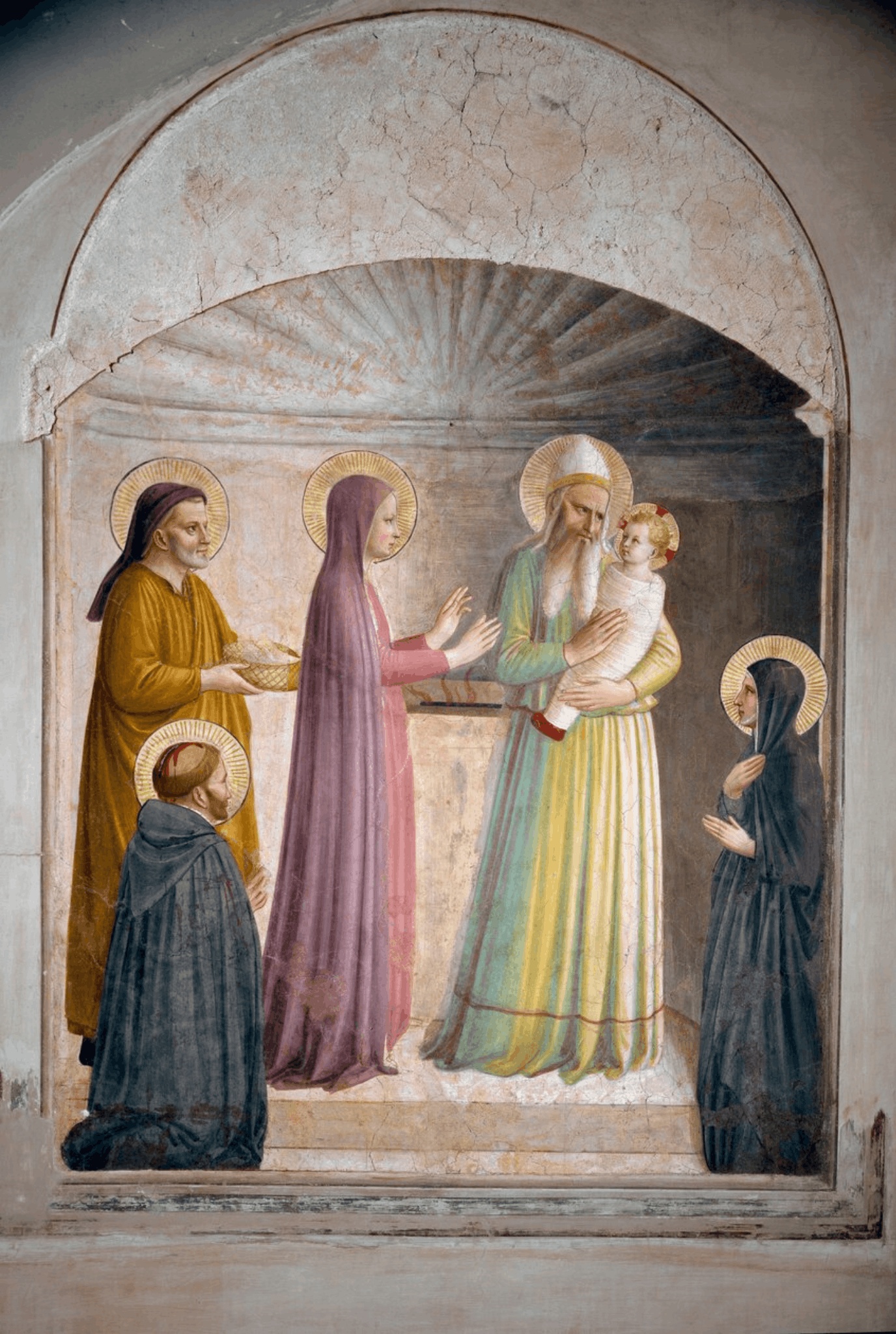
Simeon is a just and God-fearing man who lives in the temple in expectation of the Messiah. By the Holy Ghost it has been promised to him that he shall not see death before he has beheld Christ the Lord. When he meets the Child Jesus, he recognizes Him as the fulfilment of God’s promises to Israel.
In his words it becomes clear who Christ is: not only light and salvation, but also a sign which shall be contradicted. With His coming a division becomes visible between faith and unbelief; by Him the thoughts of hearts are revealed.
Simeon speaks to Mary in particular. She is pointed out as the Mother who has not only borne the Child, but who will also have a share in His way. The sword that shall pierce her soul points forward to the suffering of Christ, in which she will share in silence and in fidelity.
Thus this Gospel shows that the Incarnation of the Son of God is, from the beginning, ordered toward the sacrifice. Christmas already bears the sign of the Cross, and Mary stands from the outset within this mystery. The beginning of this temple narrative is read on 2 February (Candlemas), the Feast of the Presentation of the Lord; today we hear the continuation, with the prophecy of Simeon, read within the Octave of Christmas.
Of Anna we know almost nothing beyond this single Gospel passage. She appears nowhere else in the New Testament, and Scripture preserves for us no further details of her life. And yet the evangelist Luke portrays her here so fully and so humanly that she becomes for us a living and recognisable figure.
She was eighty-four years old. She was advanced in years, and yet she had never ceased to hope. Old age can take away the bloom and strength of our bodies; but it can do something worse still: the years can drain the life from our hearts, until the hopes we once cherished die and we grow weary and resigned to things as they are.
Here too everything depends on how we think of God. If we think of Him as distant and detached, we may easily fall into despair; but if we think of Him as intimately involved in life, as One who holds His hand upon the helm, then we too shall be sure that the best is yet to come and that the passing years will never kill our hope.
What kind of woman, then, was Anna? She never ceased to worship. She spent her life in the house of God, in the midst of God’s people. God has given us His Church to be our mother in the faith. We rob ourselves of a priceless treasure when we fail to be one with His worshipping people.
She never ceased to pray. Public worship is great; but private worship is great as well. As someone has truly said: “They pray best together who have first prayed alone.” The passing years had left Anna without bitterness and in unshakable hope, because day by day she kept her communion with Him who is the source of strength, and in whose strength our weakness is brought to perfection.
Source: Barclay, Study Bible, St Luke.