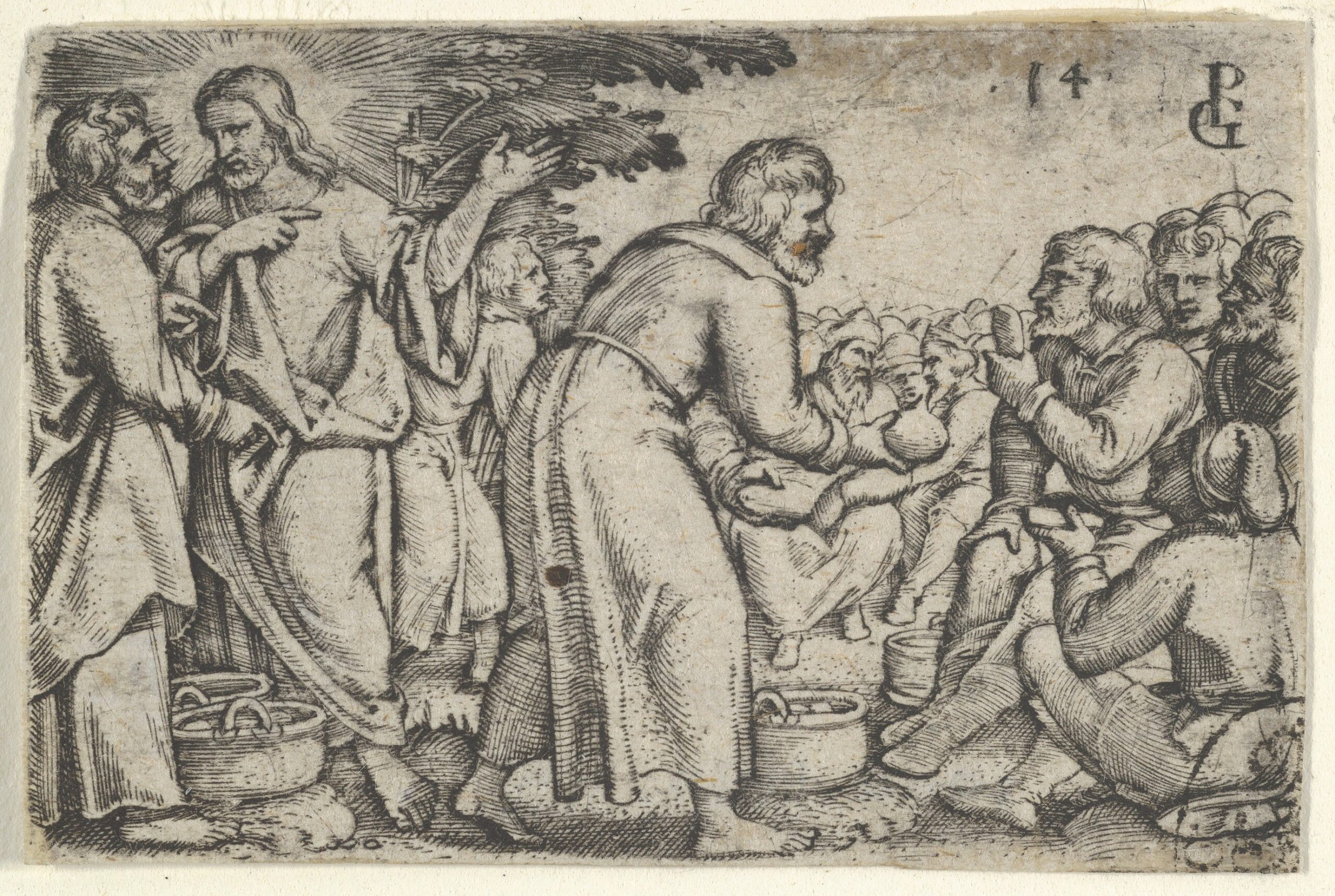
Gospel of the Sunday (John 6:1–15)
After these things Jesus went over the sea of Galilee, which is that of Tiberias. And a great multitude followed him, because they saw the miracles which he did on them that were diseased. Jesus therefore went up into a mountain, and there he sat with his disciples. Now the pasch, the festival day of the Jews, was near at hand. When Jesus therefore had lifted up his eyes, and seen that a very great multitude cometh to him, he said to Philip: Whence shall we buy bread, that these may eat? And this he said to try him; for he himself knew what he would do. Philip answered him: Two hundred pennyworth of bread is not sufficient for them, that every one may take a little. One of his disciples, Andrew, the brother of Simon Peter, saith to him: There is a boy here that hath five barley loaves, and two fishes; but what are these among so many? Then Jesus said: Make the men sit down. Now there was much grass in the place. The men therefore sat down, in number about five thousand. And Jesus took the loaves; and when he had given thanks, he distributed to them that were set down. In like manner also of the fishes, as much as they would. And when they were filled, he said to his disciples: Gather up the fragments that remain, lest they be lost. They gathered up therefore, and filled twelve baskets with the fragments of the five barley loaves, which remained over and above to them that had eaten. Now those men, when they had seen what a miracle Jesus had done, said: This is of a truth the prophet, that is to come into the world. Jesus therefore, when he knew that they would come to take him by force, and make him king, fled again into the mountain himself alone.
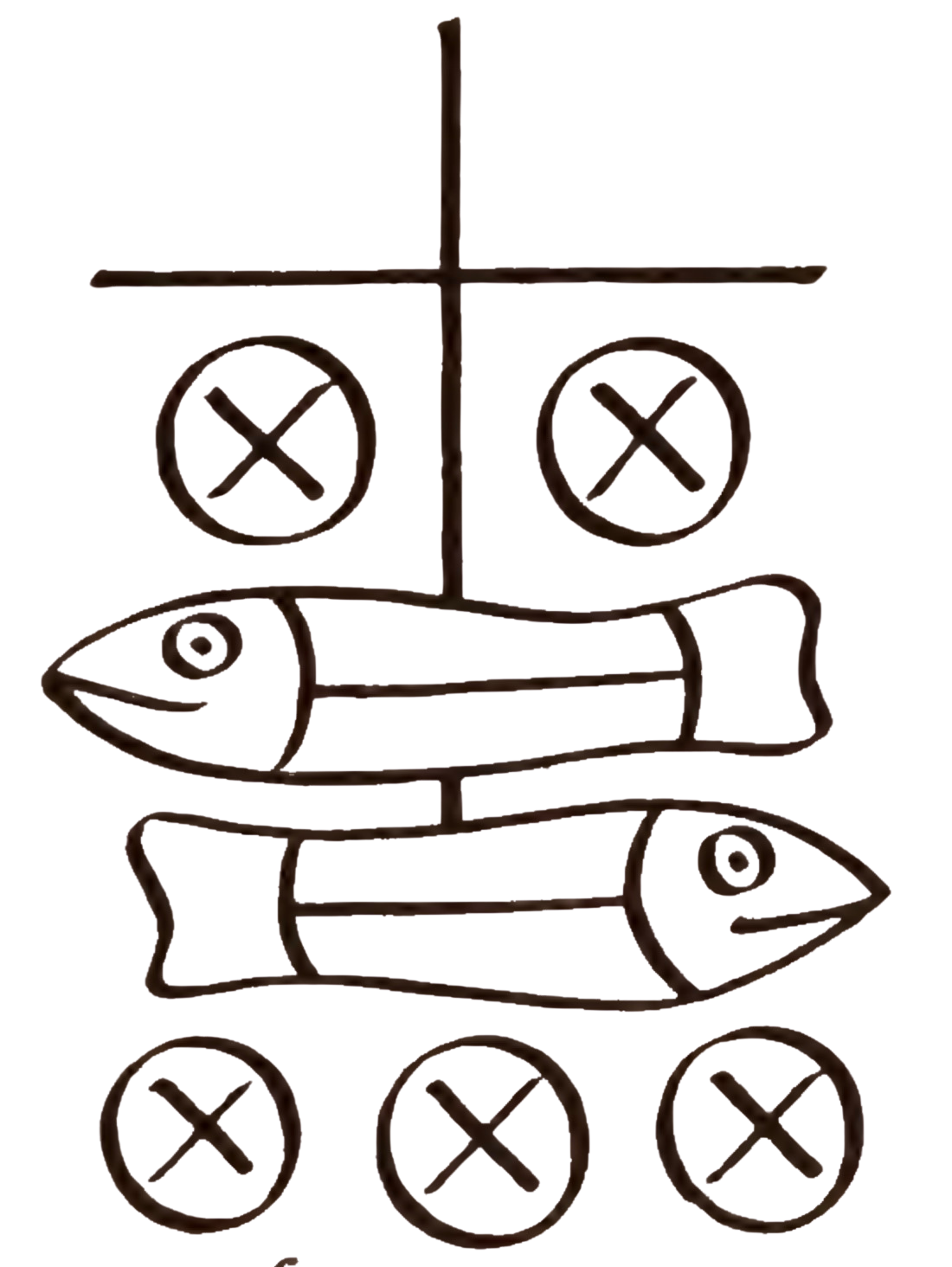
The Miraculous Multiplication of the Loaves
The miracles which our Lord Jesus Christ performed are divine works. They awaken the human mind so that, from the things that are seen, it may rise to the understanding of God. For God Himself cannot be seen with the eyes; and because the wonders that He performs every day in the governance of the world and in the order of creation have become so familiar, men scarcely notice them anymore.
Hardly anyone reflects upon the marvelous works of God that are already revealed in a single grain of wheat. Therefore, in His mercy, He performed certain works outside the ordinary course of nature, so that men, who pay little attention to daily wonders, might be led to wonder by the sight of rarer signs.
For the governing of the whole world is a greater miracle than feeding five thousand men with five loaves; yet no one marvels at the first, while everyone wonders at the second—not because it is greater, but because it is rare.
Who even now feeds the whole world, except Him who causes the grain to grow from a few seeds? What Christ did here, God has always done. By the same power by which the harvest of the fields comes forth, He also multiplied the five loaves.
In this miracle something is therefore shown to our eyes in order to stir the mind to reflection. But we must not only admire the miracle; we must also seek its meaning. The five loaves signify the five books of Moses, and they are called barley loaves because barley has a hard husk: so too in the Old Testament the spiritual meaning is hidden beneath the letter.
When the Scriptures are opened and explained, they are, as it were, broken and multiplied, so that many may be nourished by the same word. And the fragments that remained signify that in Holy Scripture there are still many profound meanings hidden, which the multitude cannot bear, but which are entrusted to the disciples. (St Augustine)
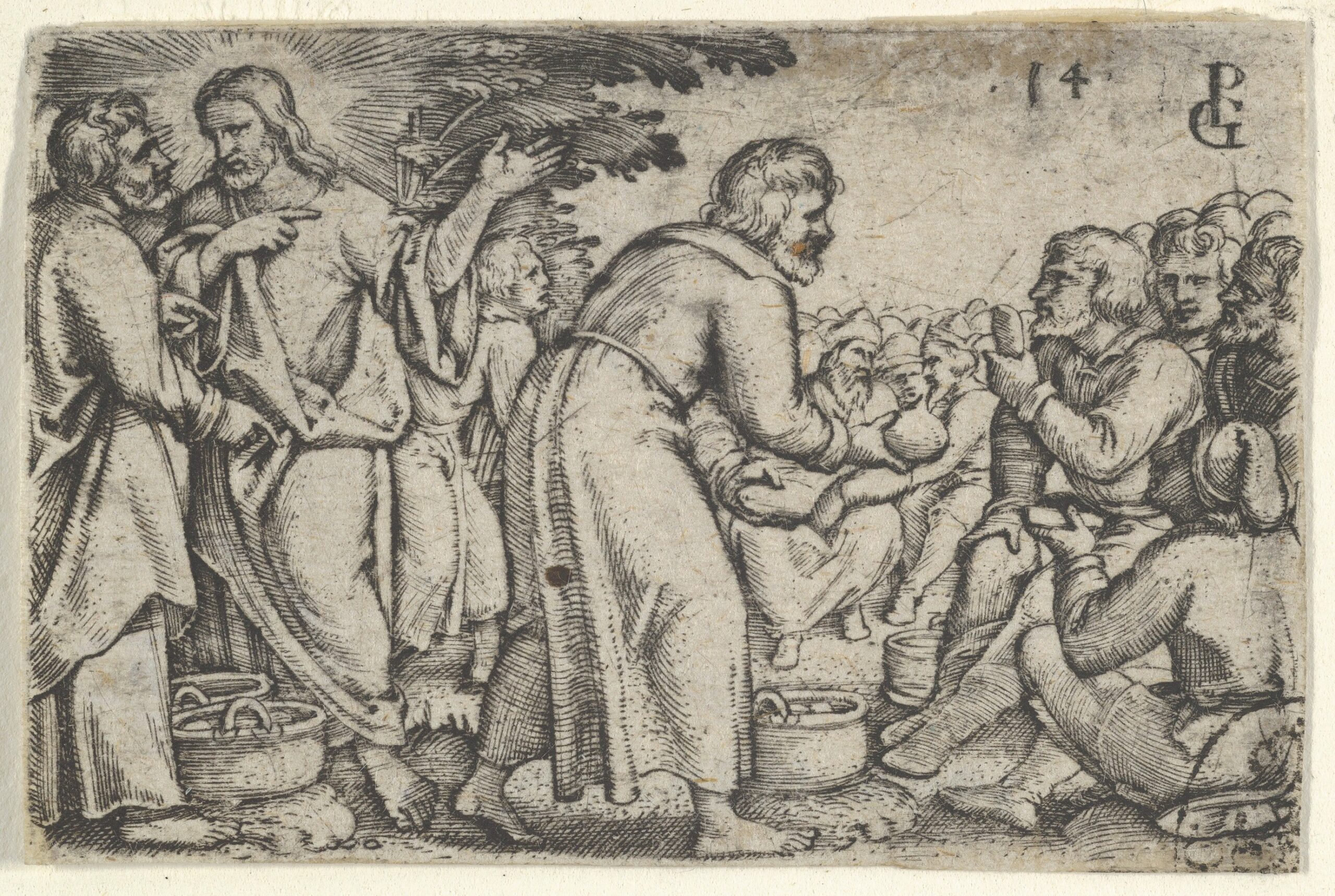
The five loaves, says Augustine, signify the five books of Moses. They are called barley loaves because barley has a hard husk: thus the letter of the Law is surrounded by a covering that must first be opened before one can reach the inner nourishment.
The two fishes signify, according to him, the two anointed dignities recognized in Israel: the priesthood and the kingship. Both find their fulfillment in Christ Himself, who is at once the true Priest and the true King.
The breaking of the loaves signifies the interpretation of the Scriptures. When the Law is opened and explained, it is, as it were, multiplied, so that many may be nourished by the same divine truth.
The twelve baskets of fragments that remained signify that the fullness of these hidden meanings is entrusted to the twelve apostles, who after the Resurrection will proclaim the Gospel to the world.