Gospel of the Sunday (Matthew 20:1–16)
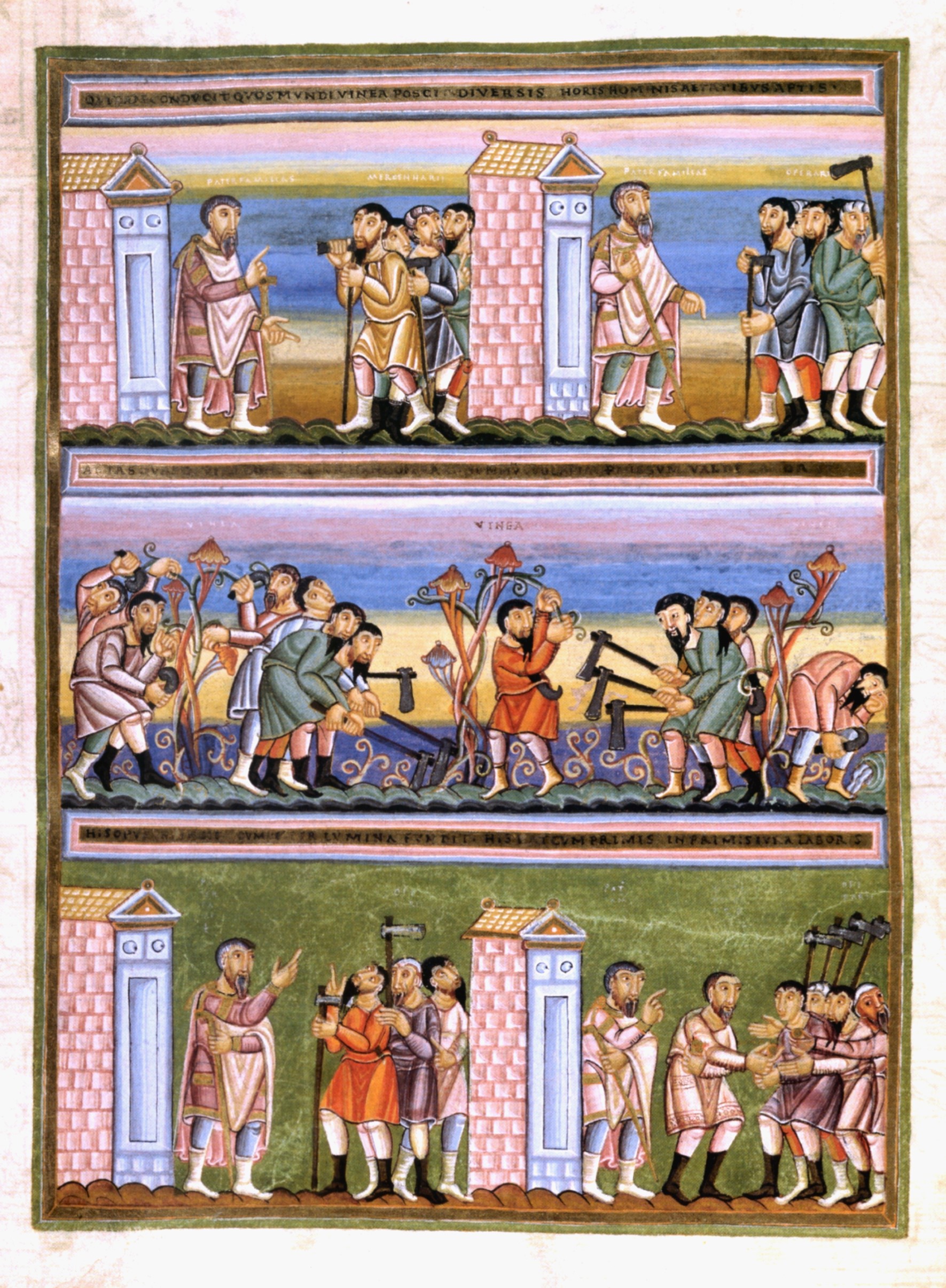
At that time Jesus spoke to His disciples this parable: The kingdom of heaven is like a householder who went out early in the morning to hire labourers for his vineyard.
After agreeing with the labourers for one denarius a day, he sent them into his vineyard. Going out about the third hour, he saw others standing idle in the marketplace, and he said to them: Go you also into my vineyard, and I will give you what is just. And they went. Again he went out about the sixth and the ninth hour, and did likewise.
But about the eleventh hour he went out and found others standing there, and he said to them: Why do you stand here all day idle? They answered him: Because no man hath hired us. He saith unto them: Go you also into my vineyard.
When evening had come, the lord of the vineyard said to his steward: Call the labourers and give them their hire, beginning from the last even to the first. When those who had come about the eleventh hour drew near, they each received a denarius. And when the first came, they thought they would receive more; but they also received each a denarius.
And when they had received it, they murmured against the householder, saying: These last have worked but one hour, and thou hast made them equal to us, who have borne the burden of the day and the heat. But he answered one of them and said: Friend, I do thee no wrong. Didst thou not agree with me for a denarius? Take what is thine and go thy way. I will give to this last even as to thee. Is it not lawful for me to do what I will with my own? Or is thy eye evil, because I am good?
So shall the last be first, and the first last. For many are called, but few are chosen.
SEPTUAGESIMA
The season of Septuagesima comprises the three weeks immediately preceding the holy season of Lent. It forms an essential part of the liturgical year and consists of three Sundays: Septuagesima, Sexagesima, and Quinquagesima. Their names express a symbolic relationship to Lent, which is called Quadragesima — forty days — during which the Church prepares for the feast of Easter through penance and restraint.
During these weeks the Church invites her faithful gradually to detach themselves from worldly distractions and to prepare inwardly for the solemn call of Ash Wednesday. Even before Lent begins, the liturgy therefore takes on a more restrained character: the Alleluia and the Gloria in excelsis are omitted and give way to a tone of quiet sobriety.
Thus Septuagesima, after centuries of development, was definitively incorporated into the cycle of the Church, where it has held its place for more than a thousand years. Its name does not indicate an exact number of days, but rather the approach of the holy forty-day fast. The Sunday of Septuagesima may fall between January 18 and February 22, which are therefore called the key days of Septuagesima.
Sermon of Saint Augustine
On the Gospel of Septuagesima Sunday (Sermon 87)
Our Lord Jesus Christ has set before us in the Gospel a parable, in which He says that the kingdom of heaven is like a householder who went out at the break of day to hire labourers for his vineyard. He agreed with them for a denarius a day and sent them into his vineyard.
He went out again about the third hour and saw others standing idle in the marketplace. To them he said: Go you also into my vineyard, and I will give you what is just, and they went. Likewise he went out about the sixth and the ninth hour and did the same. But about the eleventh hour he went out and found others standing there, and he said to them: Why do you stand here all day idle? They answered: Because no man hath hired us. And he said to them: Go you also into my vineyard.
When evening had come, the lord of the vineyard said to his steward: Call the labourers and give them their hire, beginning with the last and going to the first. Those who had come about the eleventh hour received each a denarius. When the first came, they thought they would receive more, but they also received each a denarius.
When they had received it, they murmured against the householder, saying: These last have worked but one hour, and thou hast made them equal to us, who have borne the burden of the day and the heat. But he answered one of them and said: Friend, I do thee no wrong. Didst thou not agree with me for a denarius? Take what is thine and go thy way. I will give to this last even as to thee. Is it not lawful for me to do what I will with my own? Or is thy eye evil, because I am good?
See, brethren, how here the justice of the master is not questioned, but the envy of the labourers is exposed. They received what had been promised to them and lost nothing of what was their due, yet they could not endure that others should receive what had not been promised, but was granted out of goodness. The master remained just; the labourers became envious. And what is envy if not sorrow at another’s good?
Take heed, brethren, that the last made no claim, but received what was given, while the first laid claim and thereby lost their peace. For what is murmuring if not the loss of inner peace? They carried their wages in their hands, but they did not carry peace in their hearts.
Who then are the first, and who are the last? The first are those called from the beginning: the people of Israel, who received the Law, who heard the prophets, and laboured long. The last are those called later: the Gentiles, who at the end of time were brought to the faith.
But let no one among you say: I belong to the first, for even you were called late, compared with the saints of earlier ages. Or perhaps the first are those who served God from their youth, and the last those who came to conversion only in old age.
Yet here also it holds true: no one receives the kingdom as a wage for merit, but all receive it as a gift of mercy. For if God were to judge according to works, who could stand?
Therefore take heed, brethren, that you do not trust in the length of your labour, nor in the weight of your burden, nor in the heat of the day. These things make no claim, but receive their value only from the goodness of Him who bestows the reward.
Hence the Apostle says: Not of works, lest any man should boast, and elsewhere: What hast thou that thou hast not received?
Let him who boasts, boast not in himself, but in the Lord. Let the last hope without fear, and the first fear without despair. For God rejects no one who comes to Him, and He takes away from no one what He has promised.
But He wills that all should live out of gratitude, and not out of claim. This, then, is the meaning of the parable, brethren: that the kingdom of heaven is not given according to human calculation, but according to the abundance of divine mercy.
May He who has called us to His vineyard preserve us in humility, cleanse us from envy, and lead us to that reward where there is no evening, but eternal light. Amen.
Gregorian Mass of Septuagesima (Solesmes, 1960)
Performed by the monks of the Abbey of Solesmes, under the direction of Dom Joseph Gajard.
Side I
Side II