Continuation of the holy GOSPEL according to St. Luke, 17: 11-19
AT THAT TIME: As Jesus was going to Jerusalem, he passed through the midst of Samaria and Galilee. And as he entered into a certain town, there met him ten men that were lepers, who stood afar off. And lifted up their voice, saying: Jesus, master, have mercy on us. Whom when he saw, he said: Go, shew yourselves to the priests. And it came to pass, as they went, they were made clean. And one of them, when he saw that he was made clean, went back, with a loud voice glorifying God. And he fell on his face before his feet, giving thanks: and this was a Samaritan. And Jesus answering, said: Were not ten made clean? and where are the nine? There is no one found to return and give glory to God, but this stranger. And he said to him: Arise, go thy way; for thy faith hath made thee whole.
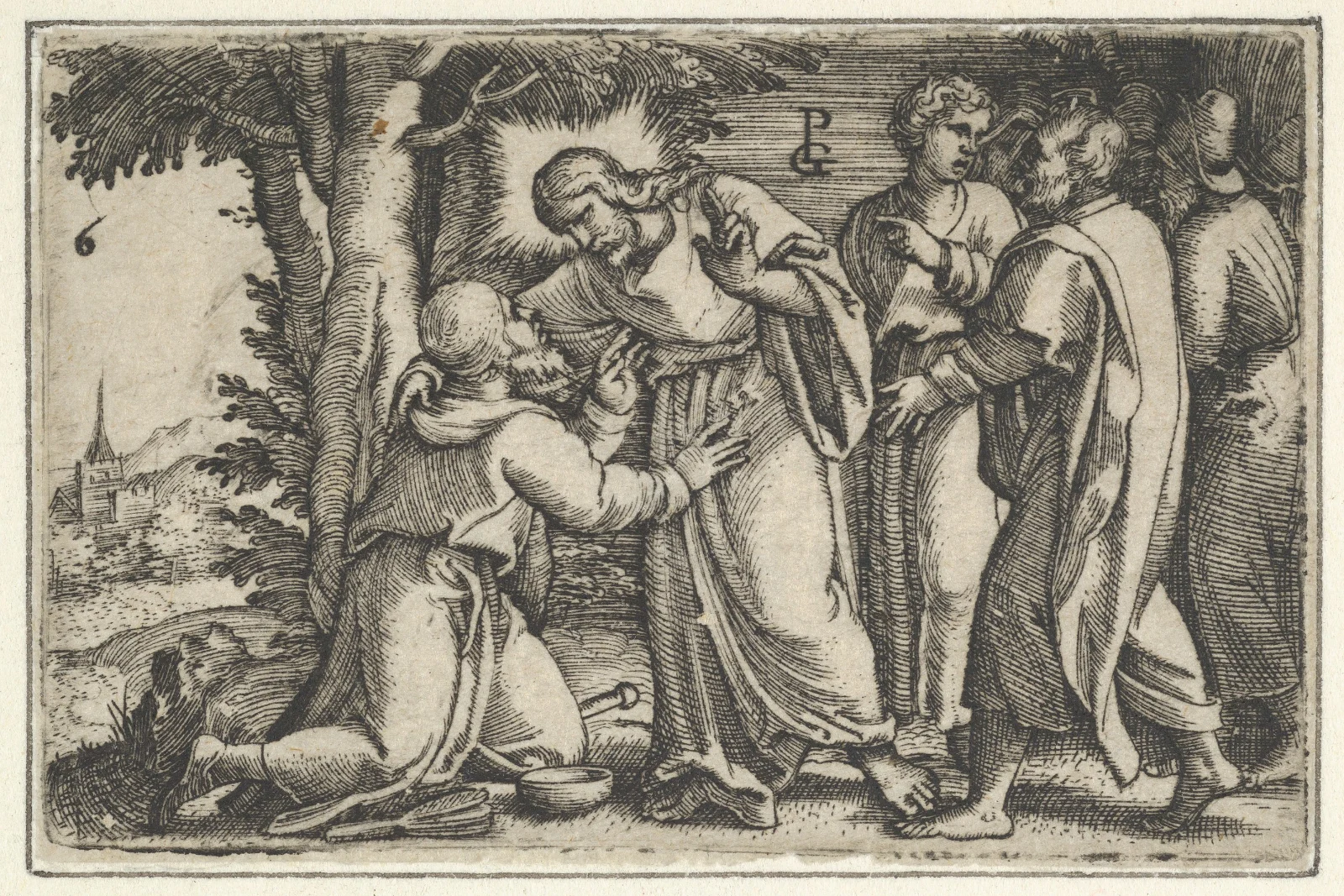
Van de tien genezen melaatsen keert alleen deze Samaritaan tot Christus terug. Christus noemt hem deze vreemdeling. In de traditionele uitleg vertegenwoordigt hij de heidenvolken die Christus erkennen en tot het heil worden geroepen. Ook in het Evangelie van de vorige zondag was het juist een Samaritaan die door Christus tot voorbeeld werd gesteld.
Dom Prosper Guéranger on the Ten Lepers
The Samaritan leper, cured of that hideous disease which is such an apt figure of sin, represents, in the midst of the nine lepers of Jewish nationality, the despised Gentile. The conduct of these ten men, on occasion of their miraculous cure, is in keeping with the attitude assumed by the two peoples whom they represent, towards the salvation offered to the world by the Son of God. It is a fresh confirmation of what the Apostle says: For all are not Israelites that are of Israel; neither are all they that are the seed of Abraham, children; but in Isaac shall thy seed be called: that is to say, not they that are the children of the flesh are the children of God; but they that are the children of the promise are accounted for the seed.
Our holy Mother the Church is never tired of this subject, the comparison of the two Testaments and, in this case, the contrast between the two peoples. We therefore deem it our duty, before going further, to explain why this is so. There are many who do not understand what utility it can be to us Christians to hear this subject continually preached to us. The kind of spiritual life which, nowadays, has taken the place, in so many souls, of the liturgical life so fully lived and so dearly loved by our Catholic forefathers, has produced a certain dislike for the thoughts which the Church, with such persistence, sets before us on so many of her Sundays. Men have become accustomed to live in a very narrow circle of truths. Everything has become subjective and, at the same time, small. They even consider it excellent to forget all teaching except the little portion which they already possess and beyond which they prefer not to venture. It is therefore not surprising that Christians of this sort are embarrassed when they see the Church continually urging them to take an interest in a distant past which they regard as having no practical utility for themselves. But the interior life which really deserves that name is not what such well meaning people imagine it to be. No school of spirituality, either now or formerly, has ever sought the ideal of virtue in indifference towards those great historical facts which are manifestly so precious in the eyes of the Church and of God Himself. And what is ordinarily the result when they thus separate themselves from what is so dear to their Mother? By deliberately shutting themselves up in their personal prayers, they lose sight, as a just punishment, of the true object of prayer, namely union with God and love of Him. Their meditation is deprived of that element of intimate and fruitful intercourse with God which all masters of the spiritual life assign to it. It soon becomes a barren exercise of analysis and reasoning, from which nothing but abstract conclusions can result.
When God in His mercy invited men to the divine nuptials by revealing to them His Word, He did not give the Son of His own eternal Being to our earth in an abstract manner. In His divinity men could not, in their present state, behold Him directly. If God, then, had shown us that eternal Son, in whom all beauty, warmth and life are found, only in an abstract manner, it would have been imperfect and cold. He did not act thus. As St Paul teaches us, He manifested the great mystery of godliness in the flesh. The Word became a living soul. Eternal Truth took a body, that He might converse with men and grow up among them as one of themselves. And when that Body, which Eternal Truth was to retain for ever as His own, was taken up into glory, the Church, the Bride of this God Man, bone of His bones and flesh of His flesh, continued this manifestation of God in the world through the members of Christ. She continued that historical development of the Word which will end only when time shall be no more. This manifestation and this development surpass all human calculation and unfold, even to the Angels, ever new aspects of the wisdom of God.
Undoubtedly, value must be attached to those principles in which great minds have summed up the elements of science in an abstract and logical order, independently of history and facts. But neither with God nor with man does such petrified theorizing possess anything of the life, influence and efficacy of living truth. In the Church, as in God, truth is life and light. Her great Credo would never resound so triumphantly through our churches, nor rise so irresistibly to heaven, if it were merely a bare series of true definitions and formulas. Its superhuman power comes from this, that almost every article and almost every word of it is steeped in the blood of martyrs and shines before the Church and God with the splendour of the labours, sufferings and struggles of thousands of holy confessors and doctors. They form, as it were, the nobility of human nature raised by Baptism, whose lives serve to bring the Body of Christ here on earth to its completion.
This subject is too rich for us to pursue it further here. But this much is certain: after the great fact of the Incarnation of the Word, who came upon earth to manifest God throughout the ages in Christ and His members, there is no fact of greater importance, nor one which has been and still is dearer to God, than the calling of the two peoples who were successively invited to the blessing of a covenant with Him. The gifts and the calling of God are, as the Apostle expresses it, without repentance on His part. The Jews who are now His enemies because they reject the Gospel are nevertheless still called most dear for the sake of their fathers. Therefore the time will come, for which the whole world waits, when the rejection of Juda shall have been removed and his iniquities blotted out. Then shall the promises made to Abraham, Isaac and Jacob be literally fulfilled. The divine unity of the two Testaments shall be made manifest, and the two peoples shall become one under their one Head, Christ Jesus. When God’s covenant with man shall thus have been wholly realized as He designed it in His eternal wisdom, when the earth shall have yielded her fruit and the world accomplished its task, the graves shall give back their dead. Then history on earth shall end and glorified human nature shall unfold itself in the unhindered fullness of life beneath the gracious gaze of God.
The truths which today’s Gospel again sets before us are therefore by no means dry or antiquated. Nothing is grander. And we must add, however much superficial minds may wonder at it, that nothing at this season is more practical, for this is the time devoted to the mysteries of the unitive life. For in what does union between God and man primarily consist, if not in the agreement of the divine and human mind? Now we know that God has revealed His designs in the history of the two Testaments and the two peoples. And the final result in which these two histories shall find their completion is the same one end which Infinite Love has willed from the beginning to accomplish, is now accomplishing, and will will for ever. When therefore the Church continually returns to these truths, she is far from showing that she does not keep pace with the times. On the contrary, she proves thereby that she is the perfectly understanding Bride of Jesus and reveals the unchanging youth of a heart which ever beats in perfect accord with the Heart of her Bridegroom.
Let us now return to the literal explanation of our Gospel. As we remarked on a former Sunday, our Jesus wishes here again rather to give us a useful instruction than to display His divine power. He therefore does not cure the ten lepers who implore His mercy in the same manner as He had, on another occasion, cured a man afflicted with the same misery. To this latter, who besought Him, He restored cleanness by a few words. This happened at the beginning of His public life. He said: Be thou made clean. And immediately the leprosy departed from him. The incident of the lepers in today’s Gospel, on the contrary, occurred in the latter part of our Lord’s sojourn among men. They are not cleansed until they are on their way to show themselves to the priests. Jesus sends them to the priests, as He had done on the former occasion. Thus, from the beginning to the end of His mortal life, He gives the example of the reverence due to the Old Law so long as it had not yet been abrogated.
This Law gave to the sons of Aaron not the power to cure leprosy, but to discern it and to pronounce whether it was or was not healed. But now the time has come for a Law far superior to that of Sinai. It possesses a priesthood whose judgments do not concern the condition of the body, but which, by pronouncing the sentence of absolution, actually removes the leprosy of souls. The cure which the ten lepers felt coming upon them before they had reached the priests ought to have been sufficient for them to recognize in Jesus the power of the new priesthood of which the prophets had spoken. That power, by acting beforehand in favour of these men, surpasses the authority of the ancient ministry. This should have been sufficient proof of the superior dignity of Him who exercises it.
Had they only possessed the proper dispositions for the sacred ceremonies which were to be performed at their purification, the Holy Ghost, who of old had inspired the prophetic details of this mysterious rite, would have made them understand the meaning of the bird offered in expiation. Its blood was mingled with living water and by means of the wood the other bird was set at liberty. The first bird represents our Lord Jesus Christ, who compares Himself in the Psalm to the solitary bird. His sacrifice upon the Cross, which gives to the water the power of cleansing souls, communicates to the other birds, His brethren, the purity of the divine Blood.
But the Jew is still far from being prepared to understand these great mysteries. And yet the Law had been given to him to lead him, as it were by the hand, to Christ without exposing him to error. It was an extraordinary favour granted to him, not on account of his own merits, but for the sake of his fathers. This favour was all the more precious because it was bestowed at a time when the tradition concerning a future Redeemer had almost entirely disappeared among the greater part of mankind. Gratitude, therefore, should above all have dwelt in the heart of Juda. But pride took its place. He became so absorbed in the honour bestowed upon him that he lost all desire for the Messiah. He cannot endure the thought that a time will come when the Sun of Justice shall have risen over the whole earth and the limited privilege granted to a few during the hours of night shall disappear before the brilliant noonday light in which all shall rejoice. Therefore he declares the Old Law definitive, although the Law itself bears witness that it is only temporary. Therefore he clings to the perpetual continuance of the kingdom of figures and shadows. He lays it down as a doctrine that no divine intervention can ever equal that of Sinai, that every future prophet and every messenger of God must necessarily be inferior to Moses, that all possible salvation lies in the Law and that from it alone every grace proceeds.
This explains why, of the ten men cured of leprosy by Jesus, there are nine who do not even think of returning to their Saviour to thank Him. These nine are Jews. In their eyes Jesus is merely a disciple of Moses, merely an instrument of benefits deriving His commission from Sinai. As soon as they have fulfilled the legal formality of their purification, they consider that they have discharged all their obligations towards God. The Samaritan, on the contrary, the despised Gentile, whose suffering has given him the humility which clears the sinner’s sight, is the only one who recognizes God in His divine works and thanks Him for His benefits.
How many centuries of apparent abandonment, humiliation and suffering must yet pass over Juda before he shall recognize and adore his God, confess his sins before Him and give Him his devoted love. Then shall he, like this stranger, hear Jesus pronounce His forgiveness: Arise, go thy way; thy faith hath made thee whole. Let us by our fervent prayers hasten the time which shall be so glorious for both peoples. Then, united in the same faith and in the consciousness of the same hope at last fulfilled, they shall cry to our Saviour the words of the Offertory: In Thee, O Lord, have I hoped. I said: Thou art my God. My lots are in Thy hands.