Continuation of the Holy Gospel according to St. Matthew, 9, 1–8
AT THAT TIME Jesus entering into a boat, passed over the water and came into his own city. And behold they brought to him one sick of the palsy lying in a bed. And Jesus, seeing their faith, said to the man sick of the palsy: Be of good heart, son, thy sins are forgiven thee. And behold some of the scribes said within themselves: He blasphemeth. And Jesus seeing their thoughts, said: Why do you think evil in your hearts? Whether is easier, to say, Thy sins are forgiven thee: or to say, Arise, and walk? But that you may know that the Son of man hath power on earth to forgive sins, then said he to the man sick of the palsy: Arise, take up thy bed, and go into thy house. And he arose, and went into his house. And the multitude seeing it, feared, and glorified God that gave such power to men.
St. John Chrysostom on the Healing of the Paralytic
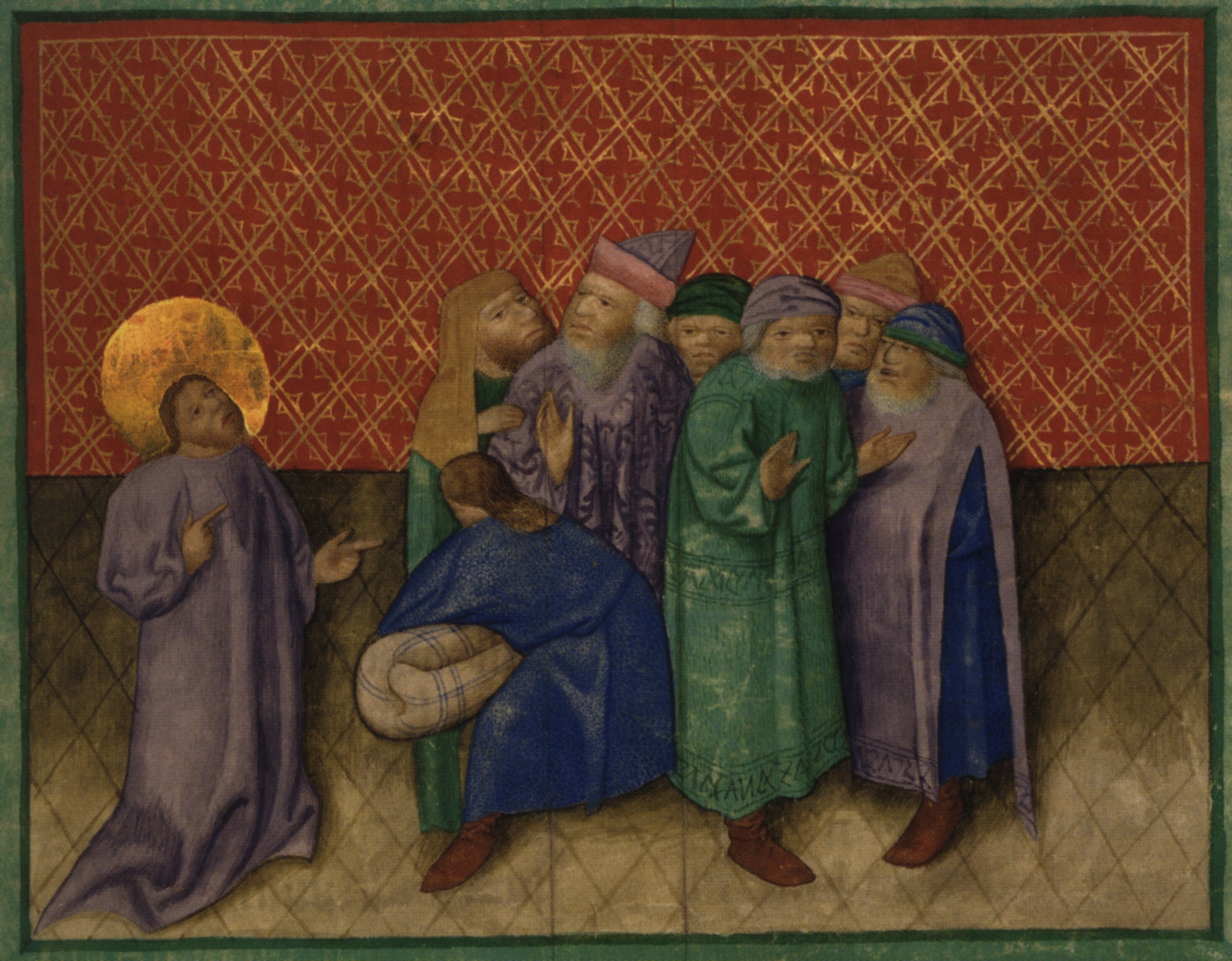
And He entered into a ship, and passed over, and came into His own city. And, behold, they brought to Him a man sick of the palsy, lying on a bed: and Jesus seeing their faith said unto the sick of the palsy; Son, be of good cheer; your sins be forgiven you. His own city means Capernaum. For one, Bethlehem, had received Him at His birth; another, Nazareth, had brought Him up; and a third, Capernaum, had Him continually as an inhabitant. This paralytic, however, was different from that one who is set forth in John. For he lay by the pool, but this man was in Capernaum; that one had been thirty and eight years afflicted, but concerning this man there is no such thing mentioned; and the former had no man to assist him, but this man had persons to tend him, who also carried him and brought him unto Him. And to this man He says, Son, be of good cheer, your sins be forgiven you, but to that man, Will you be made whole? And the one He healed on a sabbath day, but the other not on a sabbath, for had He done so, the Jews would have laid this also to His charge. But in this case they held their peace, whereas in the other they straightway persecuted Him. And this I have said not without cause, lest any one should think there was a discrepancy, from suspecting them to be one and the same paralytic. But do thou, I pray you, mark the humility and meekness of our Lord. He had already before this put away from Him the multitudes; when those on the other side of the lake sent Him away, He resisted not, but departed, only not far. And again He entered into the ship and crossed over, though He might have gone round on foot. For it was His will not always to be doing miracles, lest He should injure the doctrine of His humanity. Now Matthew indeed says, that they brought him, but the other evangelists, that they also broke up the roof, and let him down. And they set the sick man before Christ, saying nothing, but committing the whole to Him. For though in the beginning He Himself went about, and did not require so much faith of them that came unto Him, yet in this case they both approached Him, and had faith required on their part. For, seeing, it is said, their faith; that is, the faith of them that had let the man down. For He does not on all occasions require faith on the part of the sick only, as, for example, when they are mad, or through their disease in any other way deprived of their understanding. Or rather, in this case too the sick man himself had part in the faith; for he would not have suffered himself to be let down, unless he had believed. Forasmuch then as they had shown so great faith, He also shows His own power, with all authority absolving his sins, and signifying in all ways that He is of equal honor with Him that begot Him. And observe, He had hinted this from the beginning, by His teaching, when He taught them as one having authority; by the leper, when He said, I will, be thou clean; by the centurion, when upon his saying, Speak the word only, and my servant shall be healed, He marvelled at him, and commended him above all men; by the sea, when He curbed it with a mere word; by the devils, when they acknowledged Him as their judge, and He cast them out with great authority. Here again in a higher way He constrains His very enemies to confess His equality in honor, and makes it manifest by their own mouth. For whereas a great multitude of spectators were there, blocking up the entrance, insomuch that they let him down from above, to signify that He is far from vainglory, He does not immediately hasten to heal the visible body, but takes His occasion from them; and He first heals that which is invisible, the soul, by forgiving his sins; which indeed saved the man, but brought no great glory to Himself. But they, troubled by their wickedness, and wishing to assail Him, contributed even against their will to make what had been done more evident. Accordingly, He in His abundance of wisdom made use of their envy for the manifestation of the miracle. Upon their murmuring, then, and saying, This man blasphemes; who can forgive sins but God only? let us see what He says. Did He indeed take away the suspicion? And yet if He were not equal to God, He should have said, Why fix upon me a notion which is not convenient? I am far from this power. But now He said none of these things, but quite the contrary He both affirmed and ratified it, by His own word, and by the working of the miracle. Thus, because to speak anything concerning one’s self was offensive to His hearers, He establishes what He had to say of Himself by others; and what is very wonderful, not by His friends only, but also by His enemies. For this is the abundance of His wisdom. By His friends on the one hand, when He said, I will, be thou clean, and when He said, I have not found so great faith, no, not in Israel; but by His enemies here. For because they had said, No man can forgive sins but God only, He subjoined: But that you may know that the Son of Man has power to forgive sins upon the earth, then says He to the sick of the palsy, Arise, and take up your bed, and go unto your house. And not here only, but also in another case, when they were saying, For a good work we stone you not, but for blasphemy, and because that you, being a man, make yourself God, neither in that instance did He put down this opinion, but again confirmed it, saying, If I do not the works of my Father, believe me not; but if I do, though you believe not me, believe the works. Here again He gives another sign, and that no small one, of His own Godhead, and of His equality in honor with the Father. For whereas they said, To unbind sins pertains to God only, He not only unbinds sins, but before doing so He makes another display of a thing which pertains to God only, to publish the secrets of the heart. For they had not uttered what they were thinking. For behold, certain of the scribes, it says, said within themselves, This man blasphemes. And Jesus knowing their thoughts, said, Wherefore think ye evil in your hearts? But that it belongs to God only to know men’s secrets, hear what says the prophet, You most entirely alone know the hearts; and again, God tries the hearts and reins; and Jeremiah too says, The heart is deep above all things, and it is man, and who shall know him? and, Man shall look on the face, but God on the heart. And by many things one may see, that to know what is in the mind is the attribute of God alone. Thus, therefore, to signify that He is God, and equal to Him that begot Him, what things they were reasoning in themselves, these He reveals and makes manifest. For they durst not utter themselves, because of the multitude. And herein He shows His great gentleness and meekness. For, Wherefore, says He, think ye evil in your hearts? And surely if there were cause for displeasure, the sufferer should have been displeased, as being altogether deceived, and should have said, One thing I came seeking to have healed, and another do you amend; whence am I to know that my sins are forgiven? But now he for his part utters no such word, but gives himself up to the power of the Healer. But these are curious and envious, and attack the good works of other men. Wherefore He rebukes them indeed, but with all gentleness. Why, if you disbelieve, says He, what went before, and think it a boast, behold, I add unto it another thing also, the publishing of your secrets; and after that again another. What then is this? The entailing on the paralytic of a firm body. And whereas, when He spoke unto the sick of the palsy, He spoke without clearly manifesting His own authority: for He said not, I forgive you your sins, but, Your sins be forgiven you; upon their constraining, He discloses His authority more clearly, saying, But that you may know that the Son of Man has power on earth to forgive sins. Do you see, how far He was from unwillingness to be thought equal to the Father? For He said not at all, The Son of Man has need of another; or, He has given Him authority, but, He has authority. Neither does He say it for love of honor, but to convince you, so He speaks, that I do not blaspheme in making myself equal with God. Thus everywhere His will is to offer proofs clear and indisputable; as when He says, Go your way, show yourself to the priest; and when He points to Peter’s wife’s mother ministering unto them; and when He permits the swine to rush down the precipice. So here also He makes the healing of the body a proof of the remission of sins, and of the healing of the body, the carrying of the bed; that what took place might not be thought a mere fancy. And He does not this before He has asked them a question. For whether is easier, says He, to say, Your sins be forgiven you; or to say, Take up your bed, and go unto your house? Now what He says is like this, Which seems to you easier, to bind up a disordered body, or to undo the sins of a soul? It is quite clear that it is the former. For by how much the soul is better than the body, by so much is the undoing sins a greater work than the binding up a body; but forasmuch as the one is unseen, and the other is seen, I add the less, but the more open, to the greater and unseen, that hereby the greater may receive its proof; thus by His works anticipating even now the revelation of what was said by John, that He takes away the sins of the world. Well then, having raised him up, He sends him to his house; here again signifying His freedom from pride, and that the case was not a mere fancy; for He makes the very persons witnesses of his disease, who had been so of his health. For I was desirous, says He, through your calamity to heal these also that seem to be in health, but are diseased in mind. But since they will not, go your way home, that you may amend your own people. Do you see how He indicates Him to be Creator both of soul and body, healing the palsy in both, and making the cure of the one evident by the other? But still they were crawling on the ground. For, when the multitudes saw it, they marvelled, and glorified God, which had given such power unto men. For the flesh was an offense unto them. But He did not rebuke them, but proceeded by His works to arouse them, and to raise their thoughts. For for the present it was no small thing for Him to be esteemed greater than all men, as having come from God. Had they established this well in their own minds, proceeding in order they would have known that He was the Son of God. But they did not hold these things with accuracy, neither were they able to approach unto Him. For again they said, This man is not of God. How is this man of God? And they were continually harping on these things, putting them forward as cloaks for their own passions.
Source: St. John Chrysostom, Homily XXIX on Matthew, on Mt. 9:1–8, PG 57.