Continuation of the HOLY GOSPEL according to St Matthew, 5:1–12
AT THAT TIME, Jesus, seeing the multitudes, went up into a mountain, and when He was set down, His disciples came unto Him. And opening His mouth, He taught them, saying: Blessed are the poor in spirit: for theirs is the kingdom of heaven. Blessed are the meek: for they shall possess the land. Blessed are they that mourn: for they shall be comforted. Blessed are they that hunger and thirst after justice: for they shall have their fill. Blessed are the merciful: for they shall obtain mercy. Blessed are the clean of heart: for they shall see God. Blessed are the peacemakers: for they shall be called children of God. Blessed are they that suffer persecution for justice’ sake: for theirs is the kingdom of heaven. Blessed are ye when they shall revile you, and persecute you, and speak all that is evil against you, untruly, for My sake: Be glad and rejoice, for your reward is very great in heaven. For so they persecuted the prophets that were before you.
Contents
The Origin and Significance of All Saints
The Litany of All Saints
Sermon for All Saints — St Bede the Venerable
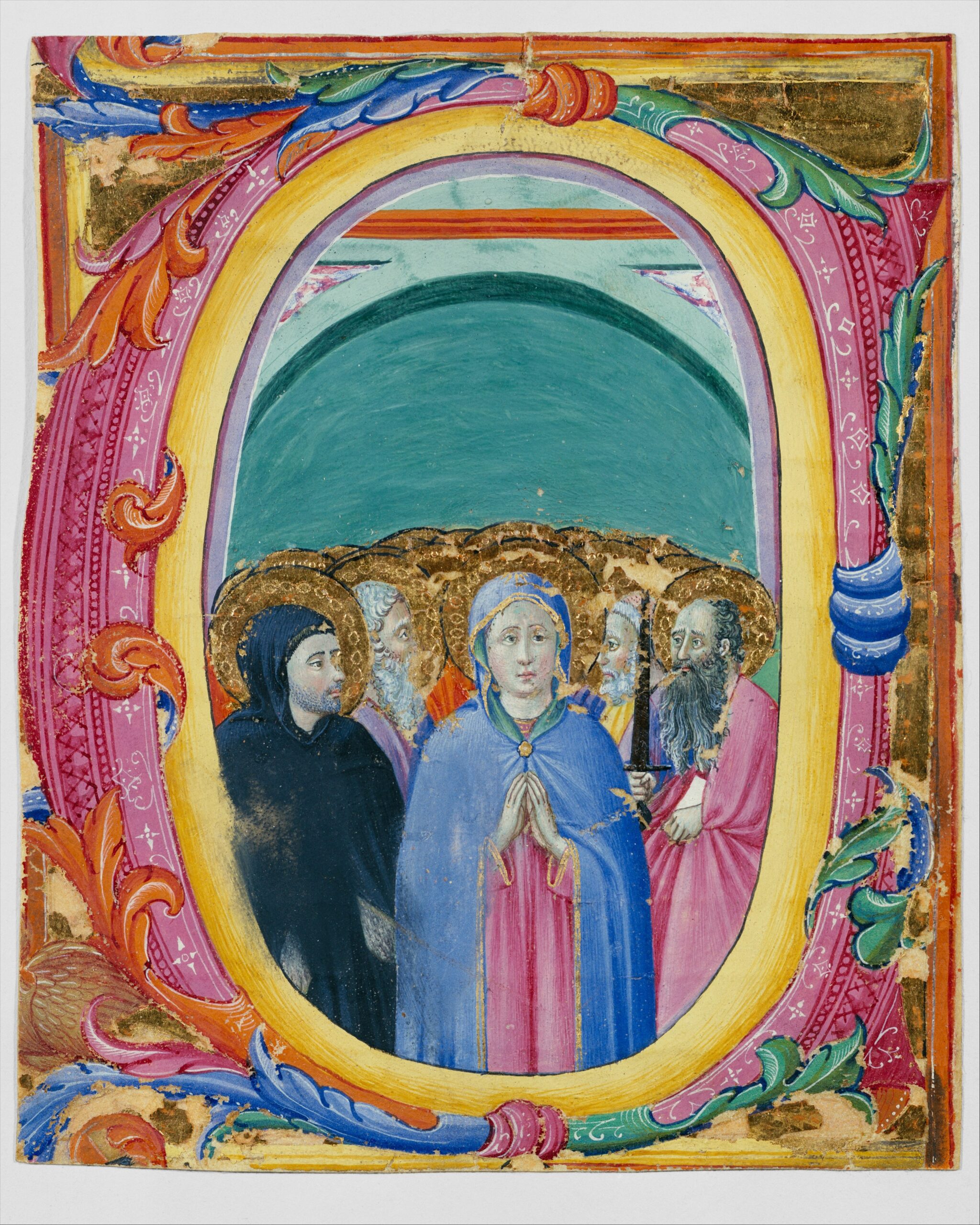
1 November — The Feast of All Saints
The Church Triumphant. The progress of autumn, with the fall of the withered leaves, and the long cycle of Sundays after Pentecost, inspiring a feeling of sadness and weariness which pervades its latter part, call our minds to the solemn thoughts of eternity and of the world beyond the grave, to which we draw ever nearer as years and months pass by. The Seer of Patmos comes today to anticipate the close of that long cycle symbolising the arduous life of the Church militant: he raises a corner of the veil and shows us the Church triumphant in all her splendour. At the beginning of this liturgical period which extends from Pentecost to Advent, it was said that the Holy Spirit would glorify Jesus: Ille me clarificabit. Today we see in what manner He has kept His promise and has poured forth upon the mystical Body of the Saviour such sanctity as now bears fruit in this great glory.
The Origin of the Feast. A collective feast of all martyrs, connected with the triumph of Christ’s Resurrection, was known in Syria in the fourth century. At Byzantium, however, it was celebrated on the Sunday after Pentecost, a custom which was also introduced for a time at Rome. This is shown by the ancient Comes, published by Morin from the famous Würzburg manuscript: Dominica in natale Sanctorum. This festival, brought from Byzantium to the banks of the Tiber, was short-lived. An ancient tradition prescribed that the Romans should keep the solemn fast of the Ember Days in the week after Pentecost, as well as the great vigil in St Peter’s. After such a tiring night vigil, it was impossible to celebrate the feast of All Saints the following morning. The Byzantine custom was therefore abandoned, and only the feast of 13 May in honour of the martyrs remained, instituted by Boniface IV when he consecrated the Pantheon as a Christian church.
The Institution of All Saints. The idea of a collective feast of all the saints, and not of the martyrs only, continued, however, to gain ground. At a time when the Iconoclasts in the East were destroying sacred images and relics, and the cemeteries of the martyrs in Latium had been deserted on account of the raids of the Lombards in the countryside around Rome, Gregory III built an oratory at St Peter’s in honour of all the saints, confessors as well as martyrs, who had died in all parts of the world. A choir of monks carried out the liturgical offices of that Vatican sanctuary, and at Mass a daily commemoration was made of all the saints whose natalis was celebrated on that day in the various churches of Christendom. The reason which determined the choice of 1 November for the feast of All Saints is not certain. The change occurred under Gregory IV (827–844), with the cooperation of Louis the Pious and the Frankish episcopate; but it has not yet been proved whether it was the Pope or the Emperor who took the initiative in the matter. Sixtus IV subsequently added the celebration of an octave to the feast.
The Sanctity of the Church. On every other day of the year the liturgy celebrates the memory of one or more individual saints. Today, however, the Lord has multiplied the nation and increased its joy, as Isaias says: Multiplicavit gentem et magnificavit laetitiam. Thus the glorification of Christ and of the Church is completed on this feast. The Spirit of the Lord, like the mysterious aromatic oil described by the Psalmist, is diffused through the entire mystical Body of Christ. He sanctifies even its lowliest member and prepares it for the highest glory. Apostles and martyrs, clergy and laity, labourers and even slaves: all have received the Holy Ghost and have been raised to heroic sanctity. (Ildefonso Schuster)

The Litany of All Saints
The Litany of All Saints is among the oldest prayers of the Church. It is sung at the Easter Vigil, on the Rogation Days and at solemn consecrations and ordinations, including the ordination of priests and bishops and the consecration of a church. In times of particular need and calamity, the intercession of the saints was also invoked by means of this litany. Above all, the litany is a solemn prayer of supplication. The Church invokes the Blessed Virgin Mary, the angels, the apostles, the martyrs and all the other saints, asking for their intercession before God. On the Feast of All Saints the Church celebrates the glory of all the saints together. Although the litany is not prescribed in the liturgy of this feast, it is particularly fitting to recite it on this day as a private prayer. Litany of All Saints.
St Bede the Venerable — Sermon for All Saints
Today, dearly beloved brethren, we celebrate with one common joy the feast of all the saints. Heaven rejoices in their fellowship, earth is gladdened by their intercession, and the Church is crowned by their victories. The more steadfast their confession amid suffering, the more splendid is their honour. For as the conflict grew, so did the glory of those who fought. The triumph of martyrdom is adorned by many kinds of suffering, and as the tortures became more severe, so the rewards grew greater.
Our holy Mother the Catholic Church, spread throughout the whole world, has learned from her own Head, Jesus Christ, not to fear insults, crosses or death. She grew stronger, not by resisting, but by enduring. All those who, as a glorious multitude, were cast into prison she inspired with the same ardour and courage to enter the struggle and gain the glory of victory.
O truly blessed Mother Church! How she shines with the honour with which the goodness of God has illuminated her! How she is adorned with the glorious blood of victorious martyrs! How she is clothed in the shining white of unblemished virginity and confession of the faith! Among her flowers neither roses nor lilies are lacking.
Let each of you, therefore, dearly beloved, strive to attain these two honours in the highest degree: the white crowns of virginity or the purple crowns of suffering. For in the heavenly host both peace and battle have their flowers, with which the soldiers of Christ are crowned.
The ineffable and immeasurable goodness of God has also provided that the time of labour and struggle should not be long or everlasting, but brief, and as it were only a moment. In this short and limited life there would be struggle and labour, but in eternal life the crown and the reward of merits.
Thus labour soon comes to an end, while the reward of merits remains without end. After the darkness of this life we shall behold the brightest light and receive a blessedness surpassing all the bitterness of suffering.
The Apostle bears witness to this when he says: The sufferings of this time are not worthy to be compared with the glory to come, that shall be revealed in us. (Rom. 8:18)
With what generous welcome does the heavenly city receive those returning from battle! She goes forth to meet them as, having overcome the enemy, they carry their trophies of victory.
Alongside the victorious men come women who have overcome not only the world but also the weakness of their sex. There also come virgins and children who by their virtues surpassed their youthful years and won a twofold glory in their struggle.
The rest of the multitude of the faithful likewise enter the royal palace of the eternal dwelling: those who preserved the purity of the faith by steadfastly observing the heavenly commandments, in mutual peace and concord.
Come then, brethren, let us enter upon the way of life. Let us return to the heavenly city, where our names are written and where we are destined to be citizens.
We are not strangers, but fellow citizens with the saints and members of the household of God; indeed, heirs of God and joint-heirs with Christ.
The gates of that city will be opened to us by perseverance, and confidence will grant us an ample entrance.
Let us therefore contemplate the glorious blessedness of that city, so far as we are able. For no human words can truly suffice to describe it.
Of that city it is said somewhere that all pain, sorrow and sighing shall pass away.
What life can be happier than this, where there is no fear of poverty and no weakness from sickness? There no one is injured, no one grows angry, no one is envious. No desire burns there, nor does any longing for honours or ambition for power trouble the heart.
There is no fear of the devil, no snare of evil spirits, no terror of hell. Death is no more, whether of body or soul, but there is joyful life through the gift of immortality.
There shall be no discord anywhere, but all shall agree and form one whole. For all the saints shall be united in perfect concord. Peace and joy shall fill everything.
Everything there shall be calm and peaceful. There is a perpetual splendour, not like the light which we now know, but more glorious in proportion as its blessedness is greater.
For of that city it is written that she has no need of the light of the sun. The almighty Lord shall enlighten her, and her lamp is the Lamb.
There the saints shall shine like stars for all eternity, and those who have instructed many shall shine as the brightness of the firmament.
Therefore there shall be no night there, no darkness, no gathering of clouds, no cold or scorching heat. There shall be a state such as eye has not seen, nor ear heard, nor has it entered into the heart of man, except for those found worthy to enjoy it.
Their names are written in the book of life. They have washed their robes in the blood of the Lamb, stand before the throne of God and serve Him day and night.
There is no old age and none of the misery of old age, for all shall come unto a perfect man, unto the measure of the age of the fulness of Christ.
But above all this is the happiness of being united with the hosts of angels and archangels, with the Thrones and Dominations, the Principalities and Powers and all the heavenly Virtues.
There we shall behold the multitudes of the saints, more brilliant than the stars: the patriarchs, radiant with faith; the prophets, rejoicing in hope; the apostles, judging the twelve tribes of Israel; the martyrs, adorned with the purple crowns of victory; and the virgins, wearing shining garlands.
But of the King who sits in their midst no human voice can speak worthily.
His beauty, His glory, His power, His honour, His splendour and His majesty surpass every word and every human understanding.
For above all the glory of the saints stands the ineffable happiness of beholding Him and of being illuminated by the brightness of His majesty.
Therefore, if it were necessary, we ought to endure torture every day, and even undergo for a short time the pains of hell, in order to see Christ coming in His glory and to be numbered among His saints.
Would it not then be worth enduring every sorrow in order to share in so great a good and so great a glory?
How great shall be the glory of the just, dearly beloved brethren! How great the joy of the saints, when every face shall shine like the sun, when the Lord shall begin to lead His people, distinguished according to their ranks, into the kingdom of His Father, and shall give each the promised reward according to his merits and works.
Then He shall give heavenly things in place of earthly, eternal in place of temporal, and great in place of small. He shall lead the saints into the vision of the Father’s glory and give them a place in heaven, that God may be all in all.
He shall give them the eternity which He promised to those who love Him, and the immortality to which He restored them by the life-giving power of His blood. He shall lead them back to paradise and open the kingdom of heaven through His faithfulness and the truth of His promise.
Let all these things be firmly impressed upon our minds. Let us acknowledge them with perfect faith, love them with our whole heart and strive to obtain them through the steadfast practice of good works.
The matter rests within the power of the one who acts, for the kingdom of heaven is taken by violence.
O man, that kingdom of heaven demands no other price than yourself. It is worth as much as you yourself. Give yourself, and you shall possess it.
Why do you concern yourself about the price?
Christ gave Himself up to gain you for the kingdom of God the Father. Therefore give yourself also, that you may be His kingdom and that sin may not reign in your mortal body, but the spirit may lead you to the attainment of life.
Let us therefore strive joyfully for the palm of victory through salutary works. Let us all fight readily and willingly in the struggle for righteousness.
Let us complete our course under the eyes of God and Christ. And now that we have already begun to rise above time and the world, may we not allow our race to be slowed by any desire for this world.
If the last day finds us advancing unhindered and swiftly in this contest of good works, the Lord shall not withhold from us the reward of our merits.
He who during persecution bestows the purple crown for suffering shall also give the white crown to those who conquer through righteousness in time of peace.
For Abraham, Isaac and Jacob were not put to death, yet by their faith and righteousness they merited the honour of being first among the patriarchs. To their banquet is added everyone found faithful, just and praiseworthy.
We must remember that we ought to do not our own will, but the will of God. For he who does His will abides for ever, as He too abides for ever.
Therefore, dearly beloved, let us be ready to fulfil the whole will of God with an undivided heart, firm faith, strong virtue and perfect charity.
Let us faithfully keep His commandments: simplicity and innocence in our lives, concord in charity, modesty in humility, diligence in fulfilling our duties, vigilance in helping those in distress, mercy towards the poor, steadfastness in defending the truth and seriousness in maintaining discipline.
Thus nothing shall be lacking in us of what belongs to the pattern of a good Christian life.
For these are the footsteps which the saints have left us as they returned to their fatherland, so that we might follow their paths and arrive at the same joy.
Let us, with them, consider paradise our fatherland.
We have already received the patriarchs as fathers. Why then should we not make haste and be eager to behold our fatherland and greet our fathers?
There a great multitude of loved ones awaits us. A numerous company of parents, brothers and children longs for our coming. They are already assured of their own salvation, but remain concerned for ours.
How great shall be the common joy when we are permitted to meet and embrace them!
What joy reigns among our heavenly fellow servants who await our coming! What exalted and everlasting happiness!
There is the glorious choir of the apostles; there the rejoicing company of the prophets. There the countless host of martyrs is crowned for its victory in battle. There the shining multitude of virgins rejoices. There, too, the steadfastness of the confessors is praised.
Those also receive their reward who have kept the commandments of the Lord and changed their earthly possessions into heavenly treasures.
If we desire to come to them, let us hasten with ardent longing, that we may soon be united with them and come to Christ.
May He Himself be our guide along this way, He who is the source of our salvation, the Prince of light and the Giver of all joy.
He who lives and reigns with God the almighty Father and the Holy Ghost.
St Bede the Venerable, Homilia LXX