Continuation of the Holy Gospel according to St. Matthew, 13:31–35
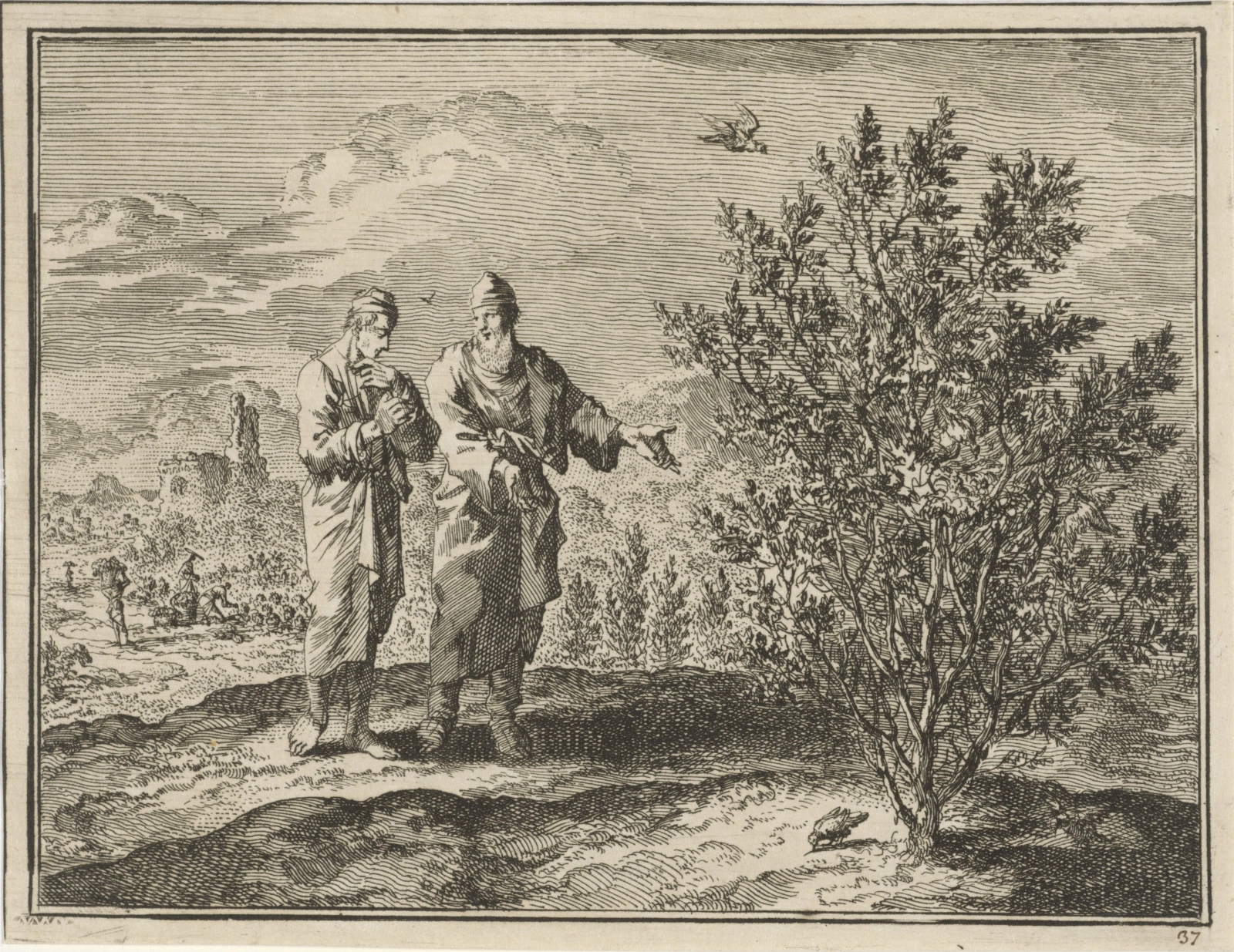
AT THAT TIME, another parable he proposed unto them, saying: The kingdom of heaven is like to a grain of mustard seed, which a man took and sowed in his field. Which is the least indeed of all seeds; but when it is grown up, it is greater than all herbs, and becometh a tree, so that the birds of the air come, and dwell in the branches thereof. Another parable he spoke to them: The kingdom of heaven is like to leaven, which a woman took and hid in three measures of meal, until the whole was leavened. All these things Jesus spoke in parables to the multitudes: and without parables he did not speak to them. That it might be fulfilled which was spoken by the prophet, saying: I will open my mouth in parables, I will utter things hidden from the foundation of the world.
On the Truth and Divinity of the Catholic Church
The kingdom of heaven is like to a grain of mustard seed. (Matt. xiii. 31.) The holy Fathers and Commentators, explaining this parable, say, that by the kingdom of heaven is here meant the Church of Christ, or his kingdom on earth. (This is evident from the parable of last Sunday, which represents the kingdom of heaven as being like to a field, wherein cockle was sown among the wheat; for this cannot be said of the kingdom of heaven otherwise than as meaning the Church or kingdom of God on earth.) Christ compares this his kingdom, that is to say, his Church, to a grain of mustard seed, both on account of the smallness of its origin; and also on account of the extent of its rapid increase. It is the least indeed of all seeds: but when it is grown up, it is greater than all herbs, and becometh a tree, so that the birds of the air come, and dwell in the branches thereof. So the Church, small as it was in its first establishment, soon increased to such a degree as to be spread over the whole world. By an effect of the divine goodness, you have been made members of this Church of all nations; you have the happiness of believing and professing its doctrines; and I will now call your attention to some of the evidences which show, that the Religion which you thus profess is true and divine; and also to that return of gratitude and fidelity, which you owe to the divine goodness for having thus called you to the true Faith.
God has established a Religion upon earth, by means of which we may render to him the homage which he requires from us—the homage of our understanding, by believing the truths which he has revealed to us, and believing them on the authority of his word,—the homage of our confidence, by a complete reliance on his divine goodness and mercy, and on his infallible promises, through the merits of Christ,—the homage of our affections, by loving him with our whole heart and soul above all things, for his own sake,—the homage of our will, by obeying and serving him in such way as he has commanded,—and the homage also of our body, by a devout performance of the external acts of religious worship. These duties must be performed according to that particular form of Religion which he himself has prescribed. Thus, the Law of Moses was prescribed by God for the Jews, and was therefore for them the only true Religion, till the coming of Christ. While Jesus Christ was on earth, he established in its place the Christian Religion, which is far more perfect—the very same which we have the happiness to profess, and which is the only true Religion in the world. Though small in its first establishment, it soon became universal.
In establishing this Religion, Christ chose twelve Apostles; he revealed to them a body of doctrines; he proved by his miracles the truth of these doctrines, because he proved thereby his divine authority to teach them; after his death and resurrection, he commissioned his Apostles to teach those same doctrines to the whole world, promising to be with them in their teaching, and with their successors, all days even to the end of the world (Mt. xxviii. 19, 20); and that the Holy Ghost should also abide with them for ever, and should guide them into all truth. (John xiv. 16; and xvi. 13.) As he cannot make false promises, it is evident that he has been with the teachers of his Church ever since, and is with them now; and that the Holy Ghost has guided and still does guide them into all truth. That Religion, therefore, which has come down from the Apostles, that is to say, that Religion which the Apostles taught, and which their successors have continued to teach in every age, must be the true one, and the only true one. In order, then, to know which is the only true Religion of Christ, we have but to look out for that one which has existed ever since; because that must necessarily be the true one.
Now, all the world knows, and is forced to acknowledge, that, amongst all the religions which now exist, ours is the oldest; that is to say, it is the only one that can be the true one; because it is the only one that has existed long enough to have had Christ and the Apostles for its founders. Ours had existed, and had been the Religion of the Christian World, above fifteen hundred years, when the proud spirit of private judgment led men to set up religions of their own, in opposition to that which had come down from the Apostles of Christ; and they called their new religions a reformation! These new religions, teaching new doctrines, and prescribing new forms of religious worship, could not have been from the Apostles, because they came into existence fifteen hundred years too late: they are therefore mere human inventions, and not divine institutions. Besides, ours is the only Religion, which verifies the parable of this day’s Gospel—the only one, which, like the grain of Mustard seed, became, after its first growth, greater than all others; so as to be the only Religion in the world, to which the term Catholic can apply.
The Catholic Church is the only one wherein there is unity of faith, the want of which is an evident mark of falsehood; because contradictions cannot come from God. As there is only one Lord, so there is only one faith, and one baptism. (Eph. iv. 5.) The religion of the reformation is divided into a thousand different doctrines or creeds: it is a kingdom divided against itself, and therefore it is not of God. (Mat. xii. 25.) But we are all united in one and the same faith, and are all under the same Head—the successor of St. Peter, whom Christ appointed to be the Head of his Church. The Catholic Church, then, is the only Religion that possesses the character of truth; it is the only one wherein we can find the real successors of St. Peter—the only one that possesses the Sacraments and Sacrifice instituted by Christ—the only one that enjoys the effect of the divine promises, which secure it in Unity and Truth, and which give us the most solid grounds for certainty.
Yet, notwithstanding these grounds for complete certainty how many of our poor fellow-creatures—how many of our own neighbours and acquaintances, allow themselves to be deluded by the spirit of error—to be tossed to and fro, and carried about by every wind of doctrine! (Eph. iv. 14.) Oh! how you, my Brethren, ought to thank God, for having preserved (or delivered) you from the unhappy delusion! how you ought to bless and praise his infinite goodness, for having chosen you out of the thousands amongst whom you live, to make you members of his One, Holy, Catholic, and Apostolic Church! And how you should endeavour to show your gratitude, by being faithful and devout in practising what your faith teaches you! Cherish in your heart, my Brethren, a strong and sincere attachment to this Religion of all ages and all nations; and be always ready to make open profession of its doctrines and practices, whenever circumstances require you to do so: For, with the heart, we believe unto justice; but, with the mouth, confession is made unto salvation. (Rom. x. 10.) Never be ashamed then of professing and practising your Religion in the presence of others, whoever they may be; for you should bear in mind those words of Jesus Christ: He that shall deny me before men, I will also deny him before my Father who is in heaven: but every one that shall confess me before men, I will also confess him before my Father who is in heaven. (Mt. x. 32.)
Source: Rev. John Perry, Practical Sermons for All the Sundays of the Year, Second Series, Sermon XIII: On the Truth and Divinity of the Catholic Church, London, 1859, pp. 79–84. Original English text.