Gospel of the Sunday (Luke 18, 9-14)
AT THAT TIME Jesus spoke this parable: And to some who trusted in themselves as just, and despised others, he spoke also this parable: Two men went up into the temple to pray: the one a Pharisee, and the other a publican. The Pharisee standing, prayed thus with himself: O God, I give thee thanks that I am not as the rest of men, extortioners, unjust, adulterers, as also is this publican. I fast twice in a week: I give tithes of all that I possess. And the publican, standing afar off, would not so much as lift up his eyes towards heaven; but struck his breast, saying: O God, be merciful to me a sinner. I say to you, this man went down into his house justified rather than the other: because every one that exalteth himself, shall be humbled: and he that humbleth himself, shall be exalted.
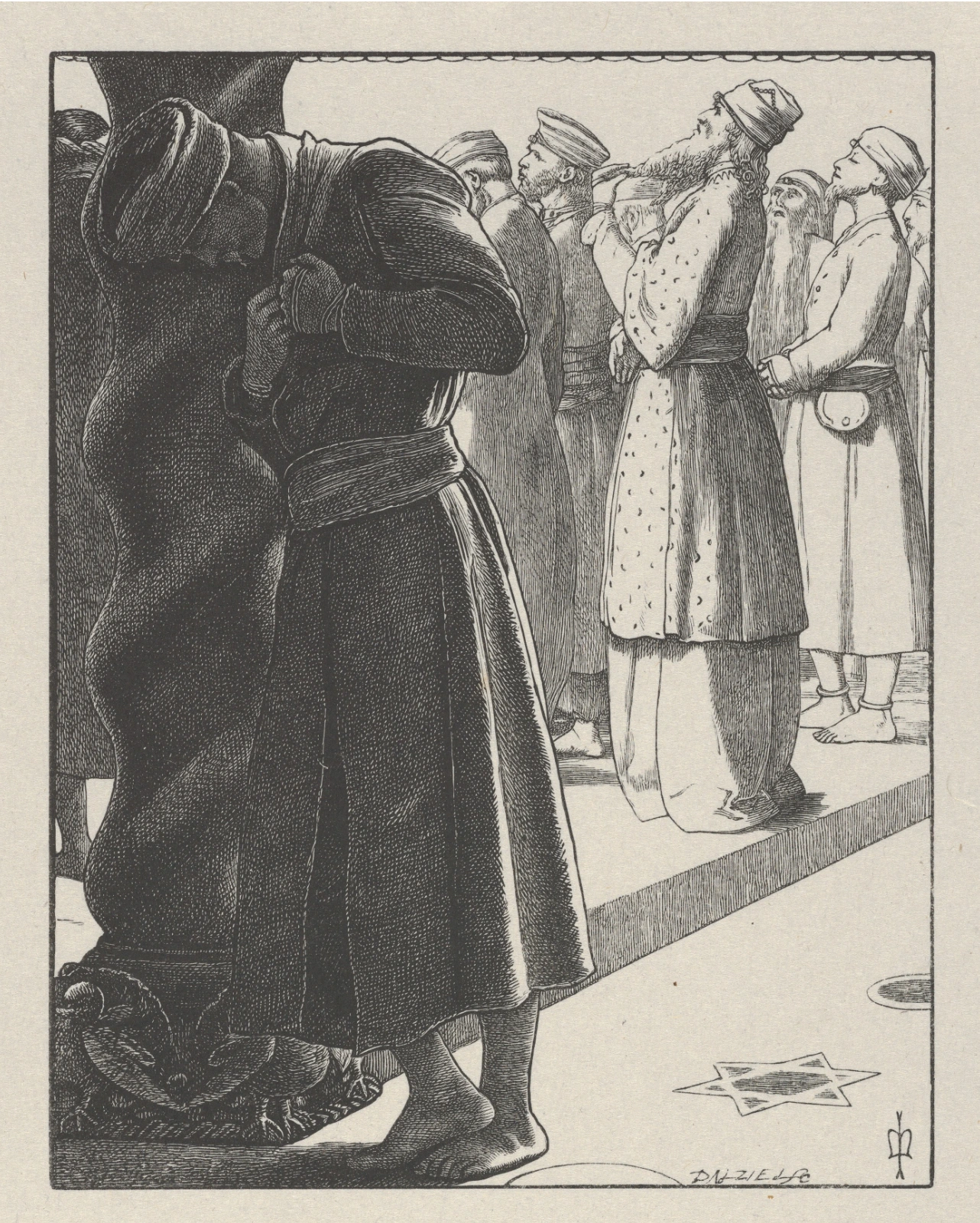
The Pharisee and the publican, after Sir John Everett Millais, 1864.
Saint Augustine on the Pharisee and the publican
Because faith belongs not to the proud, but to the humble, He spoke this parable to some who trusted in themselves as just and despised others: Two men went up into the temple to pray, the one a Pharisee and the other a publican. The Pharisee said: God, I thank Thee that I am not as the rest of men. If only he had said: as many men. For what does as the rest of men mean but all except himself? I, he says, am just, the others are sinners. I am not as the rest of men, unjust, extortioners, adulterers. And behold, the publican who stood nearby gave him still more occasion to exalt himself. As also is this publican. I alone, he says, am different, he belongs to the rest. I am not as he is, by reason of my justice, whereby I am not unjust. I fast twice in a week, I give tithes of all that I possess. Search his words for what he asked of God, and you will find nothing. He went up to pray, but he wished to ask nothing of God, he wished to praise himself. And it was not enough for him to ask nothing of God and to praise himself, he also insulted the man who was praying. But the publican stood afar off, and yet it was he who drew near to God. The consciousness of his heart kept him at a distance, but his piety brought him near. The publican stood afar off, but the Lord regarded him from near. For the Lord is high and looks upon the lowly. But the proud, such as that Pharisee, He knows from afar. He knows the exalted from afar, but He does not pardon them. Hear now further the humility of the publican. It was not enough that he stood afar off. He would not even lift up his eyes towards heaven. That he might be regarded, he himself did not look up. He dared not look upwards. His conscience weighed him down, hope raised him up. Hear yet further. He struck his breast. He exacted punishment from himself. Therefore the Lord spared him who confessed his guilt. He struck his breast and said: God, be merciful to me a sinner. Behold one who prays. Why do you wonder that God pardons, when he himself acknowledges his guilt? You have heard the case between the Pharisee and the publican. Hear now the sentence. You have heard the proud accuser, you have heard the humble culprit. Hear now the Judge. Verily, I say unto you, this publican went down from the temple to his house justified rather than that Pharisee. Tell us, Lord, the reason. Behold, I see that the publican goes down from the temple to his house more justified than the Pharisee. I ask why. Do you ask why? Hear why: For every one that exalteth himself shall be humbled, and he that humbleth himself shall be exalted. You have heard the sentence. Beware of an evil cause. I say it otherwise: you have heard the sentence, beware of pride. (St Augustine, Sermon 115, 2, PL 38, 656.)