Gospel of the Sunday (Luke 10:23–37)
AT THAT TIME Jesus said to his disciples: Blessed are the eyes that see the things which you see. For I say to you, that many prophets and kings have desired to see the things that you see, and have not seen them; and to hear the things that you hear, and have not heard them. And behold a certain lawyer stood up, tempting him, and saying: Master, what must I do to possess eternal life? But he said to him: What is written in the law? how readest thou? He answering, said: Thou shalt love the Lord thy God with thy whole heart, and with thy whole soul, and with all thy strength, and with all thy mind: and thy neighbour as thyself. And he said to him: Thou hast answered right: this do, and thou shalt live. But he willing to justify himself, said to Jesus: And who is my neighbour? And Jesus answering, said: A certain man went down from Jerusalem to Jericho, and fell among robbers, who also stripped him, and having wounded him went away, leaving him half dead. And it chanced, that a certain priest went down the same way: and seeing him, passed by. In like manner also a Levite, when he was near the place and saw him, passed by. But a certain Samaritan being on his journey, came near him; and seeing him, was moved with compassion. And going up to him, bound up his wounds, pouring in oil and wine: and setting him upon his own beast, brought him to an inn, and took care of him. And the next day he took out two pence, and gave to the host, and said: Take care of him; and whatsoever thou shalt spend over and above, I, at my return, will repay thee. Which of these three, in thy opinion, was neighbour to him that fell among the robbers? But he said: He that shewed mercy to him. And Jesus said to him: Go, and do thou in like manner.
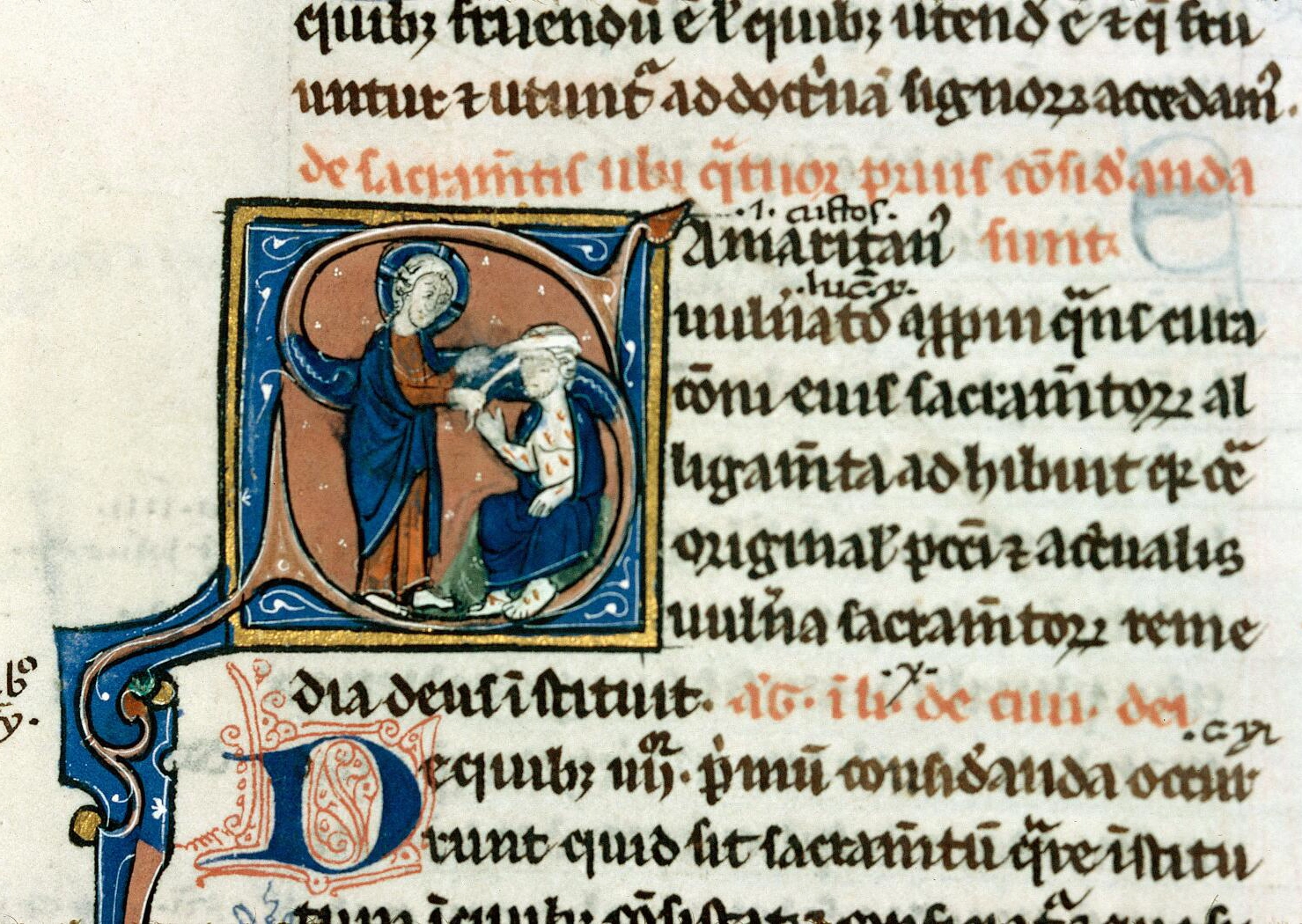
Thirteenth-century miniature. Christ is recognisable by His cross-nimbus. He bends over the traveller who has been robbed, whose body is covered with wounds, and tends him with oil and wine. The Latin text beside the image begins with Samaritanus ille, that Samaritan. The miniature presents the ancient interpretation of the parable which Origen also transmits in his homily on this Gospel: the wounded man represents man stricken by sin, while the Samaritan is Christ, who comes down to him, tends his wounds and brings him to healing.
Origen, Homily XXXIV on the Good Samaritan
On that which is written: Master, what must I do to possess eternal life? as far as the place where He says: Go, and do thou in like manner.
Although there are many commandments in the Law, the Saviour in the Gospel set forth only those commandments which lead those who obey them by a short way to eternal life. For this is what the lawyer asked Him: Master, what must I do to possess eternal life? This passage from Luke has been read to you today. He answered: What is written in the Law? How readest thou? Thou shalt love the Lord thy God with thy whole heart, and with all thy strength, and with all thy mind, and thy neighbour as thyself. Then He said: Thou hast answered right. This do, and thou shalt live. There can be no doubt that by doing this thou shalt receive eternal life, concerning which the lawyer had asked. At the same time we are clearly taught that the commandment of the Law prescribes that we love God. In Deuteronomy it is written: Hear, O Israel, the Lord thy God is one God. And thou shalt love the Lord thy God with thy whole mind, and what follows, and thy neighbour as thyself. The Saviour also bore witness to this when He said: On these two commandments dependeth the whole law and the prophets.
But the lawyer wished to justify himself and to show that no one was his neighbour. Therefore he asked: Who is my neighbour? Then the Lord related the parable which begins: A certain man went down from Jerusalem to Jericho, and what follows. He teaches that no one was the neighbour of the man who went down except him who wished to keep the commandments and prepared himself to be the neighbour of every man who needed help. For this is what is said at the end, after the parable: Which of these three, in thy opinion, was neighbour to him that fell among the robbers? Neither the priest nor the Levite was his neighbour, but, as the lawyer himself answered, he who showed mercy to him was his neighbour. Therefore the Saviour says: Go, and do thou in like manner.
One of the presbyters, wishing to interpret the parable, said that the man who went down was Adam, Jerusalem paradise, Jericho the world, the robbers the hostile powers, the priest the Law, the Levite the prophets, and the Samaritan Christ. He interpreted the wounds as disobedience, the beast as the body of the Lord, and the inn, that is, the dwelling-place which receives all who wish to enter, as the Church. The two denarii he understood as the Father and the Son, and the innkeeper as the head of the Church, to whom its administration has been entrusted. The Samaritan’s promise to return, he said, represented the Second Coming of the Saviour. Although these things are reasonably and beautifully said, we must nevertheless not suppose that they apply to every man. For not every man goes down from Jerusalem to Jericho, nor do all men dwell in this world for that reason, although He who was sent came for the lost sheep of the house of Israel. The man who went down from Jerusalem to Jericho therefore fell among robbers because he himself wished to go down.
The robbers are none other than those of whom the Saviour says: All others, as many as have come before me, are thieves and robbers. He fell, however, not among thieves, but among robbers, who are far worse than thieves. When, going down from Jerusalem, he fell into their hands, they stripped him and inflicted blows upon him. What are these blows? What are the wounds with which man is wounded? Vices and sins. After the robbers had stripped and wounded him, they did not remain with the naked man, but wounded him further, left him and went away. Therefore it is written: They stripped him, and having wounded him went away, while he was not dead, but half dead.
Now it happened that along the same road first a priest and then a Levite went down. Perhaps they had done some good to other men, but not to this man who had gone down from Jerusalem to Jericho. The priest saw him. I think that the Law saw him. The Levite saw him. In my judgement this is the word of the prophets. When they had seen him, they left him and passed by. For Providence preserved the half-dead man for Him who was stronger than the Law and the Prophets, namely for the Samaritan, whose name is interpreted as Guardian. He it is who shall neither slumber nor sleep, that keepeth Israel. For the sake of the half-dead man this Samaritan set out on His journey. He did not go down from Jerusalem to Jericho as did the priest and the Levite. Or, if He did go down, He went down for this very purpose, to save and preserve the dying man. The Jews said to Him: Thou art a Samaritan, and hast a devil. Although He denied that He had a devil, He would not deny that He was a Samaritan. For He knew that He was the Guardian.
When He had come to the half-dead man and saw him lying in his own blood, He was moved with compassion and approached him in order to become his neighbour. He bound up his wounds and poured in oil mingled with wine. He did not say what is written in the prophet: There is no medicine to be applied, nor oil, nor bandage. This is the Samaritan whose care and assistance are needed by all who are in an evil condition. Above all, the man who went down from Jerusalem, fell among robbers, was wounded by them and left half dead, needed the help of this Samaritan. That you may know that this Samaritan, according to the Providence of God, went down to heal him who had fallen among robbers, it is evident that He had bandages, oil and wine with Him.
I think that the Samaritan carried these not only for this one half-dead man, but also for others who had been wounded for various reasons and needed bandages, oil and wine. He had with Him the oil of which it is written: That he may make the face cheerful with oil. Without doubt, by this oil the swelling of the wounds of him who was being tended was also soothed. With the wine He moreover cleanses the wounds, adding something sharp. Then He placed the wounded man upon His beast, that is, upon His own body, in accordance with the fact that He deigned to assume man. This Samaritan bears our sins and suffers for us. He carries the half-dead man and brings him to the inn, that is, to the Church, which receives all and refuses her help to none. To her Jesus invites all when He says: Come to me, all you that labour, and are burdened, and I will refresh you.
After bringing him inside, He does not depart immediately, but remains one day with the half-dead man in the inn and tends his wounds, not only by day but also throughout the night, bestowing upon him all His further care and diligence. When on the following morning He wishes to continue His journey, He takes from His tried silver, from His tried money, two denarii and entrusts them to the innkeeper, without doubt the angel of the Church, whom He commands to care diligently for the man and restore him completely to health, after He Himself had also tended him for the short time available. The two denarii seem to me to be the knowledge of the Father and the Son, and the knowledge of the mystery of how the Father is in the Son and the Son in the Father. These are given as payment to the angel, that he may care all the more diligently for the man entrusted to him. He is promised that whatever he spends from his own resources for the healing of the half-dead man will immediately be repaid.
Truly, this Guardian of the Law and prophecy, this Guardian of souls, became the neighbour of him who fell among robbers. He showed mercy to him and proved himself his neighbour, not so much by words as by deeds. Since it is therefore possible for us, according to what follows, to imitate Christ, to have compassion upon those who have fallen among robbers, to approach them, bind up their wounds, pour in oil and wine, place them upon our own beast and bear their burdens, the Son of God exhorts us to do this. Therefore He speaks not so much to the lawyer as to us all: Go, and do thou in like manner. If we likewise do this, we shall obtain eternal life in Christ Jesus, to whom be glory and dominion for ever and ever. Amen.