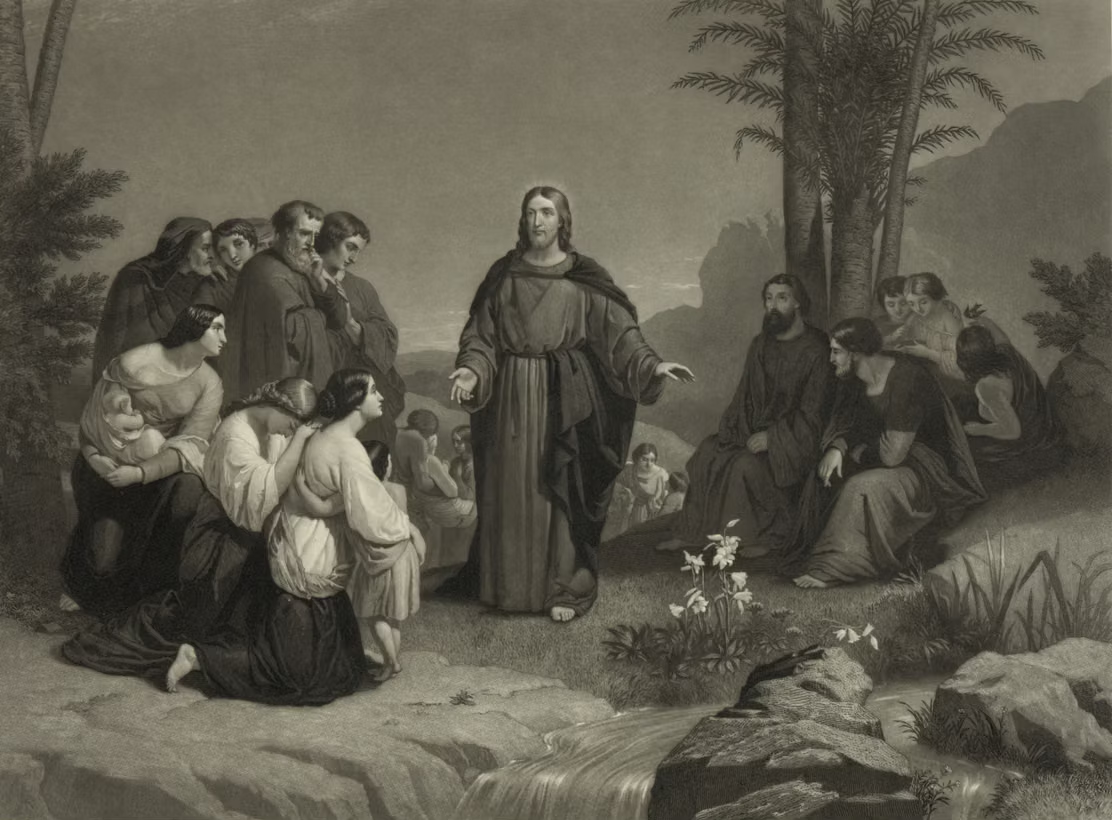
Continuation of the holy GOSPEL according to St Matthew, 6, 24-33
AT THAT TIME Jesus said to His disciples: No man can serve two masters. For either he will hate the one, and love the other: or he will sustain the one, and despise the other. You cannot serve God and mammon. Therefore I say to you, be not solicitous for your life, what you shall eat, nor for your body, what you shall put on. Is not the life more than the meat: and the body more than the raiment? Behold the birds of the air, for they neither sow, nor do they reap, nor gather into barns: and your heavenly Father feedeth them. Are not you of much more value than they? And which of you by taking thought, can add to his stature by one cubit? And for raiment why are you solicitous? Consider the lilies of the field, how they grow: they labour not, neither do they spin. But I say to you, that not even Solomon in all his glory was arrayed as one of these. And if the grass of the field, which is to day, and to morrow is cast into the oven, God doth so clothe: how much more you, O ye of little faith? Be not solicitous therefore, saying, What shall we eat: or what shall we drink, or wherewith shall we be clothed? For after all these things do the heathens seek. For your Father knoweth that you have need of all these things. Seek ye therefore first the kingdom of God, and his justice, and all these things shall be added unto you.
Consider the lilies of the field, how they grow. (Matthew 6, 28)
St Anthony of Padua on the lilies of the field
Consider the lilies of the field, how they grow: they labour not, neither do they spin. But I say to you, that not even Solomon in all his glory was arrayed as one of these. (Matthew 6, 28-29) Here the Gloss says: What royal purple, what work of weavers can be compared with flowers? The colour itself is called the clothing of the flowers, just as we say that someone is clothed with redness. Solomon, who shone above all others, was not in all his glory arrayed as one of these flowers. For he could not clothe himself with a snow-white colour as the lily is clothed, nor with a rosy colour as the rose, and likewise with the other colours. In the moral sense. Note that in the lily there are three things: healing virtue, whiteness and fragrance. The healing virtue is in the root, the whiteness and fragrance in the flower. They signify penitents, the poor in spirit, who crucify their members with their vices and concupiscences. They possess humility in the heart, which restrains the swelling of pride, the whiteness of chastity in the body, and the fragrance of a good name. They are called lilies of the field, not lilies of the desert nor of the garden. In the field two things are signified: constancy in holiness and perfection of charity. The field is the world. (Matthew 13, 38) As difficult as it is to remain there as a flower, so glorious is it. In the desert the hermits bloom, who keep themselves from intercourse with men. In the enclosed garden the religious bloom, who are protected by human guardianship. But it is more glorious for penitents to bloom in the field, that is, in the world, where the twofold grace of the flower is easily lost, namely the beauty of a good life and the fragrance of a good name. Therefore Christ glories that He is the flower of the field, when He says in the Canticle: I am the flower of the field. (Canticle of Canticles 2, 1) Thus also the Blessed Mary, His Mother, may glory, who did not lose her flower in the world, although she was neither enclosed nor a religious, and considered it more glorious to bloom in the world than in the garden or in the desert. Although, as Augustine says, it is more dangerous to attempt this, the happiness is greater when one is able to accomplish it. For battles are commonly fought in the field, and in the world the combat is continual, waged against us by the flesh, the world and the demons. There the constancy of holiness is necessary, which must remain unshaken amid all dangers. He who wishes to go forth to battle in the field must first prove whether he can stand firm in so cruel a combat. It is better to bloom in the garden or in the desert than to wither in the field. Far better is it to stand firm there than to fall here. Also in their being called lilies of the field is shown the perfection of charity, whereby they make themselves available to everyone who wishes to pluck them. Give to every one that asketh thee, says the Lord, namely a good will if thou hast not the means, and if thou hast both, so much the more perfectly. Consider therefore the lilies of the field, how they grow: they labour not, neither do they spin. Note these three things: they grow, they labour not, and they spin not. Therefore the just grow from virtue to virtue, because they labour not and spin not, that is, they twist no threads together. They labour not at the bricks of Egypt, that is, at the pleasures of the flesh. They spin not, that is, they twist not the various threads of their thoughts about temporal things. Dost thou wish to grow? Labour not then for thyself and spin not for the world, and thus thou shalt be poor. Therefore Joseph says in Genesis: God hath made me to grow in the land of my poverty. (Genesis 41, 52) In the land of poverty, that is, in humility of heart, the just man grows. When he becomes less in himself, God grows in him. Therefore John the Baptist says: He must increase, but I must decrease. (John 3, 30) When thou makest thyself less, God grows in thee. Therefore Isaias says: The least shall become a thousand, and a little one a most strong nation. (Isaias 60, 22) This happens when he who is humble in his own eyes is exalted in the perfection of spirit and work. Therefore it is written in the Psalm: Man shall come to a deep heart: And God shall be exalted. (Psalm 63, 8) Deep may be said both of what is above and of what is below, as the deep heaven and the deep sea. When therefore thou approachest the deep heart, that is, the depth of the heart, namely humility, then God is exalted in thee, because He raises thee above all wherein there is vanity and vexation of spirit. (Ecclesiastes 1, 14) Consider therefore, ye temporal men, ye fleeting lovers of time, ye who labour and are burdened (Matthew 11, 28), ye who spin endless threads, how the lilies of the field grow.
Source: St Anthony of Padua, Sermon for the Sunday.