Continuation of the HOLY GOSPEL according to St. Luke, 14, 1–11
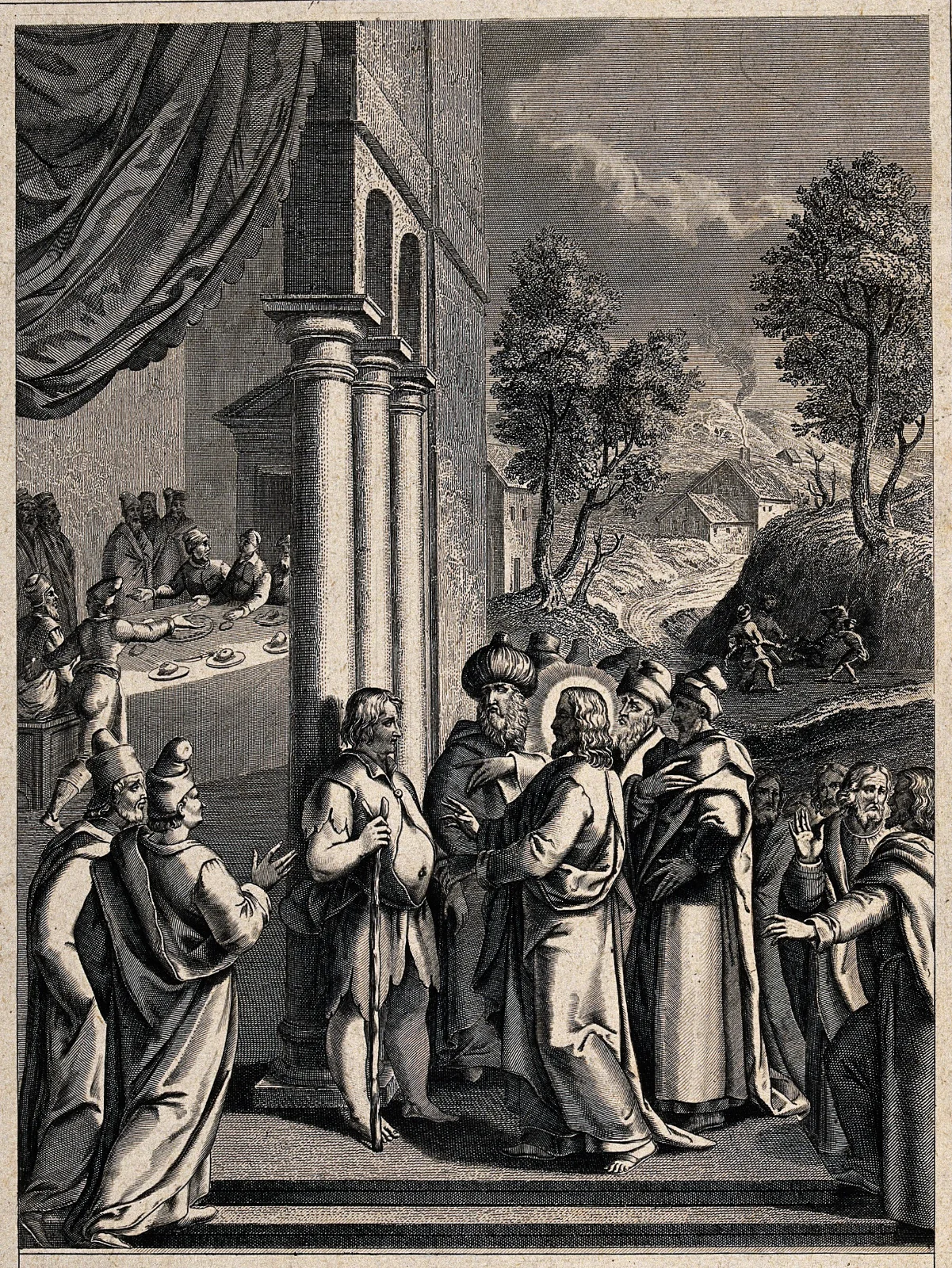
AT THAT TIME, when Jesus went into the house of one of the chief of the Pharisees, on the sabbath day, to eat bread, they watched him. And behold, there was a certain man before him that had the dropsy. And Jesus answering, spoke to the lawyers and Pharisees, saying: Is it lawful to heal on the sabbath day? But they held their peace. But he taking him, healed him, and sent him away. And answering them, he said: Which of you shall have an ass or an ox fall into a pit, and will not immediately draw him out, on the sabbath day? And they could not answer him to these things. And he spoke a parable also to them that were invited, marking how they chose the first seats at the table, saying to them: When thou art invited to a wedding, sit not down in the first place, lest perhaps one more honourable than thou be invited by him: and he that invited thee and him, come and say to thee: Give this man place. And then thou begin with shame to take the lowest place. But when thou art invited, go, sit down in the lowest place; that when he who invited thee cometh, he may say to thee: Friend, go up higher. Then shalt thou have glory before them that sit at table with thee. Because every one that exalteth himself, shall be humbled; and he that humbleth himself, shall be exalted.
Commentary upon the Gospel according to St. Luke 14, 7–11
THE SAVIOUR never ceases from doing something that is profitable unto salvation. By admonitions and counsels He leads those who draw near unto Him unto a correct line of conduct, and teaches them the sobriety that becomes the saints, that as Paul says, the man of God may be perfect, complete unto every good work. For He seizes upon every occasion, however slight, for words of exhortation, and weaves, as it were, from every circumstance, instruction worthy of our attention. In this He resembles a diligent husbandman: for whatsoever is blameworthy and reprehensible, and covers with shame those who are guilty of it, He cuts away from our minds, and plants, so to speak, every fruit of virtue. For, as the Scripture says, we are God’s husbandry. What benefit then He has here found for us, we learn from the passage just read. He was eating on the sabbath day with one of the Pharisees, at his special request. And what His purpose was in so doing, and the reason of it, we have explained unto you at our last meeting. But when He saw certain of those that were bidden foolishly taking the uppermost places, as though this were something important and desirable, and that they were seeking after vainglory, He makes for their benefit and ours an urgent recommendation, saying: When thou art bidden of any one, sit not down in the highest room, lest a more honourable man than thou be bidden of him, and when he who bade thee and him cometh, he say unto thee, Give this man place; and then thou begin with shame to take the lowest room. For such things as these are perhaps thought by some to be but trifling, and hardly worthy of attention. But when any one fixes upon them the eye of his mind, he will learn what blame they deliver a man from, and how greatly they conduce to his proper behaviour. For in the first place, it shows a man to be foolish, rude, and haughty, if he seek for honours not suitable to him, nor such as he has any right to claim, but rather those which belong to others who are greater and more honourable than himself. And such conduct makes a man hated, and often also an object of ridicule, when he has to restore to others, and that often against his will, the honour which in no respect belongs unto him. For when, He says, a more honourable man than thou cometh, he who invited thee and him will say, Give this man place. O what great ignominy is there in this! It is like a theft, so to speak, and the restitution of stolen goods. He must restore that which he has seized upon, for he had no right to take it. But the modest and praiseworthy man, who might without fear of blame have claimed the dignity of sitting among the foremost, seeks it not, but yields to others what might be called his own, that he may not even seem to be overcome by vainglory. Such a one shall receive the honour that is due unto him. For he shall hear, He says, him who invited him say, Come up higher. A modest mind therefore is a great and surpassing good. It delivers those who possess it from blame and contempt, and from the charge of vaingloriousness. But, says the lover of vainglory, I wish to be famous and honourable, and not despised and forgotten, and numbered among the unknown. If, however, thou desire this transitory and human glory, thou wanderest from the right way by which thou mightest become truly illustrious, and win a praise worthy of being sought after. For it is written, All flesh is grass, and all the glory of man as the flower of grass. And the prophet David also rebukes those who love temporal honours; concerning whom he says, Let them be as the grass upon the housetops, which withereth before it is plucked up. For as the grass that springs up upon the housetops has no deep and firm root, and therefore easily withers, so he who values worldly honour, after having flourished for a little while, and been, so to speak, in bloom, sinks at last into nothingness. If therefore a man wish to be set above others, let him win it by the decree of heaven, and be crowned with those honours which God bestows. Let him surpass many by having the testimony of glorious virtues. But the rule of virtue is a lowly mind that loves not boasting. Yea, it is humility. And the blessed Paul also counted it worthy of all esteem. For writing to those who eagerly desire a holy life, he says: Love humility. And the disciple of Christ praises it, writing: Let the poor brother glory in his exaltation, and the rich in his humiliation, because as the flower of the grass he shall pass away. For the mind that is moderate and restrained is exalted with God: for God, it is said, will not despise a contrite and humbled heart. But whosoever thinks great things of himself, and is supercilious, and elate in mind, and prides himself on an empty loftiness, is rejected and accursed. He follows a road opposed to that of Christ, Who said: Learn of Me, for I am meek and lowly in heart. For the Lord, it is said, resisteth the proud, but giveth grace unto the humble. And the wise Solomon also shows in many places how safe a thing a lowly mind is. At one time he says, Exalt not thyself, lest thou fall. And at another time he declares the same thing in a figurative manner: He that buildeth his house high seeketh a downfall. Such a one is hateful unto God, and with good reason, because he has wrongly estimated himself, and foolishly striven to rise above the limits of his nature. Upon what ground, I ask, does man upon earth think great things of himself? His mind is weak, and easily drawn into base pleasures. His body is under the dominion of corruption and death, and the duration of his life is short and limited. Nor is this all. Naked were we born. Riches, possessions, and worldly honour therefore come to us from without, and are not really ours, because they do not belong to the properties of our nature. Why then is the mind of man puffed up? What does he possess that can raise him to arrogance and pride? If a man would only regard his condition with understanding eyes, he would become like Abraham, who was not mistaken concerning his nature, and called himself dust and ashes. And like another who says, Cease ye from man, who is corruption, and from the son of man, who is a worm. But he who is a worm and corruption, this dust and these ashes, this utter nothingness, becomes great and admirable and honourable before God by knowing himself. For thus is he crowned by God with honour and praise. For the Saviour and Lord of all gives grace unto the humble. By Him and with Him be praise and dominion unto God the Father, with the Holy Ghost, for ever and ever. Amen.