Continuation of the Holy Gospel according to St. Matthew, 13:24-30.
At that time, Jesus proposed to the multitudes this parable: The kingdom of heaven is likened to a man that sowed good seeds in his field. But while men were asleep, his enemy came and oversowed cockle among the wheat and went his way. And when the blade was sprung up, and had brought forth fruit, then appeared also the cockle. And the servants of the goodman of the house coming said to him: Sir, didst thou not sow good seed in thy field? Whence then hath it cockle? And he said to them: An enemy hath done this. And the servants said to him: Wilt thou that we go and gather it up? And he said: No, lest perhaps gathering up the cockle, you root up the wheat also together with it. Suffer both to grow until the harvest, and in the time of the harvest I will say to the reapers: Gather up first the cockle, and bind it into bundles to burn, but the wheat gather ye into my barn.
Why are we celebrating a Sunday after Epiphany at this time of year?
8 November 2026 – Today, according to the Missal of 1962, we celebrate the Fifth Resumed Sunday after Epiphany. Since the date of Easter varies each year, it is not always possible to celebrate all six Sundays after Epiphany before the beginning of Septuagesima. The Sundays that remain are therefore, as far as possible, resumed towards the end of the liturgical year. Consequently, on 15 November we shall celebrate the Sixth Resumed Sunday after Epiphany, and on 22 November the Last Sunday after Pentecost. This last Sunday is always reserved for the Sunday immediately preceding the beginning of Advent on 29 November.
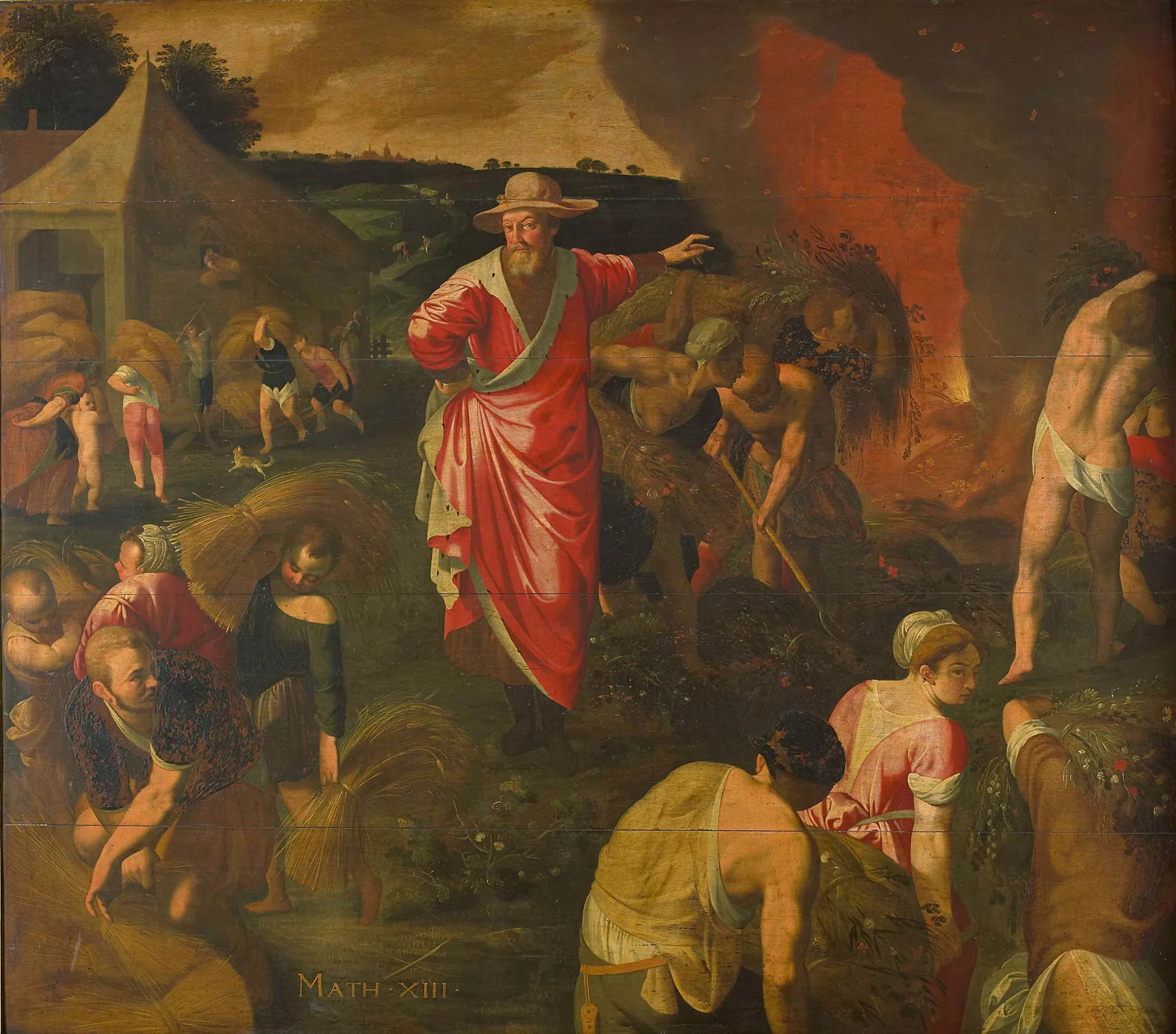
The illustration depicts the parable from the Gospel. An enemy sows tares among the wheat. When the servants discover the tares, they wish to uproot them. The master forbids them, since they might uproot the wheat as well. Both must be allowed to grow until the harvest. Then the tares will be gathered and burned, while the wheat will be stored in the barn. Later in the same chapter, Christ explains that the harvest signifies the end of the world and that the reapers are the angels (Matthew 13:36–43).
St John Chrysostom (c. 347–407), Archbishop of Constantinople and Doctor of the Church, explains the parable of the wheat and the tares in his forty-sixth homily on the Gospel of St Matthew. The homily also treats other parables. Only the complete section concerning the Gospel reading for this Sunday, Matthew 13:24–30, is reproduced below.
What is the difference between this parable and the preceding one? In the former, Christ speaks of those who have not received Him at all, but have turned away from Him and rejected the seed. Here, however, He speaks of the communities of heretics. In order that this too might not trouble His disciples, He foretells it to them, after having taught them why He speaks in parables. The first parable therefore concerns those who do not receive Him, whereas this one concerns those who receive deceivers. For this too belongs to the devices of the devil: continually to place error beside the truth and to make it resemble the truth as closely as possible, so that those who are easily misled may be deceived all the more readily. Therefore Christ does not speak of some entirely different seed, but of tares which bear a certain outward resemblance to wheat. He then describes the manner in which the enemy acts. While men were asleep, He says. By these words He points to a great danger for those to whom the care of the field has been particularly entrusted, but not only for the shepherds; the danger also concerns those committed to their care. He likewise indicates that error comes after the truth, as the events themselves testify. For after the prophets came the false prophets, after the Apostles the false apostles, and after Christ the Antichrist. When the devil sees nothing to imitate and no one against whom to direct his attacks, he undertakes nothing and does not even know how to proceed. Thus, when he saw that the seed brought forth fruit in one place a hundredfold, in another sixtyfold, and elsewhere thirtyfold, he took another course. Since he had been unable to take away what had taken root, or to choke it or cause it to wither, he devised another stratagem and secretly scattered his own inventions among the good seed.
But what is the difference between those who sleep and those who are compared with the wayside? In the latter case, the devil immediately took away the seed and did not even allow it to take root. Here, however, he needed greater cunning. Christ says all this in order to teach us to remain constantly watchful. For even when you have escaped the dangers already mentioned, another danger still remains. Just as in the former parable the wayside, the rocky ground and the thorns caused destruction, so here it is caused by sleep. Constant vigilance is therefore necessary. For this reason Christ also said: He that shall persevere unto the end, he shall be saved. Something similar happened even in the beginning. For several ecclesiastical authorities admitted into the churches wicked men who presented themselves as orthodox believers, while in reality they adhered to heretical doctrines, thus making it easy for such snares to be laid. Once the devil has planted them among us, he scarcely needs to exert himself any further. But how is it possible not to sleep, someone may ask. As regards natural sleep, this is impossible; but as regards the watchfulness of the soul, it is certainly possible. Therefore Paul also says: Watch ye, stand fast in the faith.
Christ then shows that the enemy’s work is not only harmful but also superfluous. For after the field has already been cultivated and there is no further need for sowing, the enemy comes to sow again. Thus also the heretics act, spreading their own poison out of vainglory. Christ describes their manner of acting precisely, not only by this circumstance but also by what follows. And when the blade was sprung up, and had brought forth fruit, then appeared also the tares. Such is also the conduct of these men. At first they conceal themselves, but once they have gained confidence and someone has entrusted to them the teaching of the Word, they pour forth their poison. Why does Christ then introduce the servants, who report what has happened? In order to make clear that it is wrong to put heretics to death. He calls the sower of the tares an enemy because he inflicts harm upon men. Although his enmity is directed against us, it originates not in hatred of us, but in hatred of God. From this it becomes evident that God loves us more than we love ourselves.
Consider also in this the malicious cunning of the devil. He did not sow earlier, because at that time there was as yet nothing to destroy. Only when everything had been accomplished did he begin his work, in order to frustrate the labour of the husbandman. So great was his unceasing hostility towards Him. Notice also the affection of the servants. How eagerly they wish to uproot the tares at once, although in doing so they would act rashly! This shows their concern for the crop. They are not thinking of punishing the enemy, but solely of preserving what has been sown. How can they remove the evil as quickly as possible? That is their intention. Yet even in this they do not wish to act on their own authority, but await the judgement of their master and ask: Wilt thou that we go and gather them up? What, then, does the master do? He forbids them, saying: Lest perhaps gathering up the tares, you root up the wheat also together with them. He says this in order to prevent wars, bloodshed and slaughter. For it is not lawful to put a heretic to death, since this would give rise to irreconcilable conflict throughout the world.
For two reasons, therefore, He restrains them: first, lest the wheat suffer harm; and secondly, because punishment will certainly overtake those who persist incurably in their wickedness. If, therefore, you wish them to be punished without injury to the wheat, I command you to wait until the proper time. But what do the words mean: Lest perhaps gathering up the tares, you root up the wheat also together with them? Either He means that, if men take up arms and put heretics to death, many of the saints will necessarily perish with them; or that many of those who are now tares may be changed and become wheat. If, therefore, you uproot them prematurely, you do harm to those who may yet become wheat, by killing men for whom conversion and amendment are still possible. Christ therefore does not forbid us to reprove heretics, to restrain their speech, or to break up their assemblies and associations, but He does forbid us to kill them. Observe His gentleness. He does not merely pronounce His judgement and issue a prohibition, but also gives the reasons for it.
But what, then, if the tares remain until the end? Then I will say to the reapers: Gather up first the tares and bind them into bundles to burn them. Here Christ again recalls the words of John the Baptist and reveals Himself as Judge. As long as they remain among the wheat, we must spare them, for it is possible that they themselves may yet become wheat. But when they have departed from this life without having profited in any way from the time granted to them, inexorable punishment will necessarily overtake them. For I will say to the reapers: Gather up first the tares. Why first? So that the righteous may not be afraid, as though the wheat too were to be carried away with the tares. And bind them into bundles to burn them; but gather the wheat into My barn.