Gospel of the Sunday (Matthew 7:15–21)
AT THAT TIME, Jesus said to His disciples: Beware of false prophets, who come to you in the clothing of sheep, but inwardly they are ravening wolves. By their fruits you shall know them. Do men gather grapes of thorns, or figs of thistles? Even so every good tree bringeth forth good fruit, and the evil tree bringeth forth evil fruit. A good tree cannot bring forth evil fruit, neither can an evil tree bring forth good fruit. Every tree that bringeth not forth good fruit shall be cut down, and shall be cast into the fire. Wherefore by their fruits you shall know them. Not every one that saith to Me, Lord, Lord, shall enter into the kingdom of heaven, but he that doth the will of My Father who is in heaven, he shall enter into the kingdom of heaven.
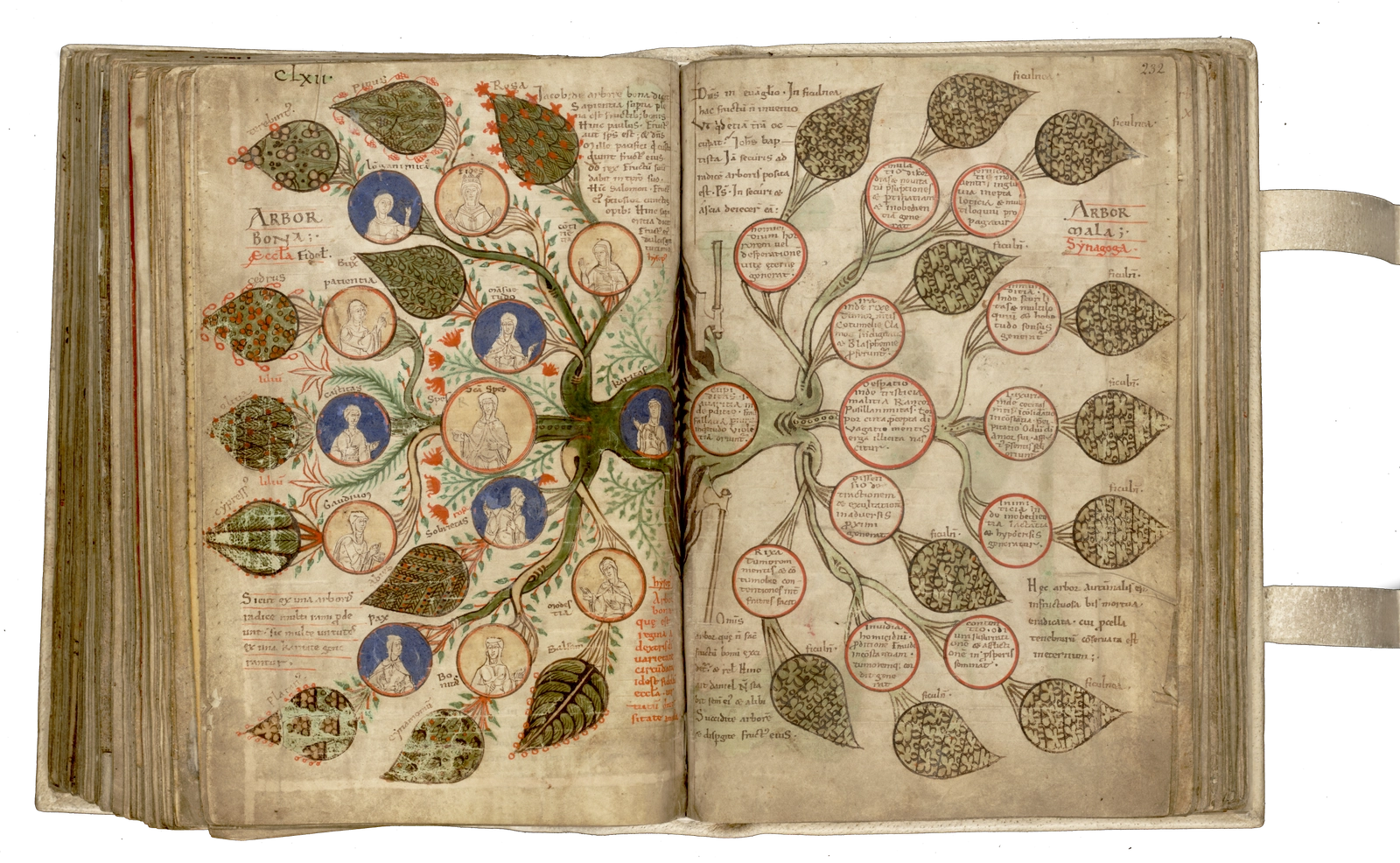
The good and the bad tree. Miniature from the Liber Floridus of Lambert of Saint-Omer, compiled about 1120. On the left stands the arbor bona, the good tree, rich in leaves and fruit. On the right stands the arbor mala, the bad tree, whose barren branches and leaves represent the fruitlessness of evil. The medallions and inscriptions show the consequences of virtues and vices. The image closely accords with the words of Christ: Every good tree bringeth forth good fruit, and the evil tree bringeth forth evil fruit. Wherefore by their fruits you shall know them. Matthew 7:17–20. Ghent University Library, Liber Floridus, MS 92, ff. 231v–232r.
Beware of false prophets, &c. Christ passes on to a most salutary admonition concerning the taking heed of false teachers, who teach that the way to heaven is not strait, but easy, and who thus send those who follow them not to heaven but to hell. They teach that we need not fast, nor go to confession, nor preserve virginity, nor religious vows. They allow all sorts of liberty to the flesh, and take away all merit from good works.
Observe, a prophet in Scripture means not only one who foretells future events, but many other persons, such as holy and religious men, singers, workers of miracles, and here as in many other places, a doctor or teacher. For the prophets were teachers, who made known the way of life, and of understanding things which were not plain to others, whether he foretold future events or not. For in Hebrew a prophet is called a seer, because he sees secret and hidden things, especially such things as future events. False prophets therefore are false teachers, whether they be heretics, or Gentiles and Pagans.
Now the sheep’s clothing which these wolves put on are to veil their errors and heresies, first under the plea of liberty of conscience. 2. By quoting texts of Scripture that serve to favour their heresies. 3. The pretext of reforming the morals of the Church, especially those of the clergy and ecclesiastics. 4. By the simulation of meekness, simplicity, and piety. 5. By soft speeches, and a garrulous eloquence by which they cover their wolfish ferocity.
Which come, in truth, from themselves, neither called nor sent, nor approved by the bishops and prelates of the Church. Concerning these it is said in Jeremias 23:21: I have not sent these prophets, yet they ran.
By their fruits, &c. Do men gather? As grapes are not wont to be produced by or gathered off thorns, nor figs off thistles, so in like manner, no good or sweet fruit can be collected from heresy or heretics, but only harsh and thorny fruit. This fruit is of two kinds. 1. Of false doctrine. 2. Of bad morals and wickedness.
Luther and Calvin have given examples in this age. For Luther teaches that vows are not binding upon the religious, that man does not possess free will, that he is the slave of necessity, that he must sin, that faith alone justifies, that good works have no merit before God. Calvin teaches that God is the author of evils, that Christ despaired on the Cross, that He felt the pains of hell, which things are downright blasphemy, and contrary to the natural law and to reason.
Calvin also maintained that the Faith, by which he meant his own perversion of it, should be defended and propagated by force of arms, even by the slaughter of lawful princes and kings, of bishops, priests, and Catholics who opposed it. Whence we have heard of, and almost seen with our eyes in England, France, and Germany, so many murders, robberies, banishments of priests and Catholics, and a vast deluge of iniquity, and as it were a universal conflagration of goodness.
We have seen the Blessed Sacraments profaned, the Holy Sacrifice abolished, vows broken, the saints contemned, churches burnt, the sacred canons set at nought, virgins violated, and all such like. For, as John Fisher, Bishop of Rochester, who, with Thomas More, was a glorious martyr in England under Henry VIII, truly says: Lust is at once the mother and the child of heresy.
So every good tree, &c. For a good tree is not distinguished from an evil one by its leaves or flowers, says S. Bernard in Epistle 107, but by its fruit.
Observe, 1. By good tree in this place, we are not to understand a good will, or charity, and by a corrupt tree an evil will, as S. Augustine, Chrysostom, and others think, but a good or bad teacher, for about these the words immediately preceding are spoken. Note, 2. By the fruit of the tree, that is, of a doctor, must be understood his doctrine, which comes forth true from a true teacher, false from a false one.
A good tree cannot bring forth evil fruit, &c. A thorn tree cannot produce grapes, nor thistles figs, but a thorn must produce thorns, and a thistle thistles, as I have said. And vice versa, a vine cannot produce thorns, but grapes. Although the grapes and the figs should not ripen, but remain sour, that does not arise from the fault of the vine, or the fig tree, but from unseasonable weather, and deficiency of the sun’s heat.
In like manner a prophet, that is, a true teacher, cannot teach false doctrine, nor can a false teacher teach the truth, or act altogether rightly and holily. You must take this in a composite and formal sense, so far, that is, as the teacher is good or bad, because in a concrete and material sense, the good doctor may fall away from his goodness, and teach or do wicked things. The Scribes taught right, but their deeds were evil. The converse also of this is sometimes true.
Many heretics have wrested this sentence of Christ, applying it falsely for the establishing of their own heresies. For first, the Manichaeans endeavoured to prove from it that some men are by nature good and others evil, or that there are two natural Principles, one good, which makes some men good, the other evil, which makes some men bad. 2. Jovinian maintained from these words that a man who is born of God is not able to commit sin. See S. Jerome, Contra Jovinian. 3. The Pelagians inferred from it that there is no original sin, because from a good marriage as from a good tree, such an evil fruit as sin cannot be produced. Teste S. Augustine, De Nuptiis et Concupiscentia, chapter 26. 4. The Donatists gathered from it that wicked priests, as bad trees, cannot properly baptize. 5. The Calvinists argue from it that there is no free will in man to bring forth good works, or bad.
The same infer from it that we are not justified by good works, but only declared righteous, since a tree is not made good by its good fruits, but is manifested by them to be good. But all these things are falsely inferred. They have none of them anything to do with the passage. For Christ properly applies this maxim only to prophets, that is, to true or false teachers, as I have said.
Not every one that saith unto Me, &c. Behold here Christ clearly describes the fruit of a good tree, that is, of a good doctor and Christian, that verily it is to do the will of our Heavenly Father, that in truth thou shouldst not only believe in Him and in His law as set forth by Christ, but that thou shouldst in deed, and in all things, fulfil the same. So says S. Augustine in the second book of The Sermon on the Mount.
Therefore Christ says: Not every one that saith unto Me, Lord, Lord. That is, not every one who believeth in Me as Lord and God, or invokes Me as such, or who often has My name on his lips, in attestation of his words and his doctrine, as though he were preaching the pure Gospel, as the heretics boast. Such a one, I say, shall not enter into the Palace and Kingdom of Heaven’s Father, but he who shall do that Father’s will, that is, who shall fulfil His Commandments.
And these are two. 1. To believe in Christ, with an orthodox faith. 2. To perform in act and deed the commands of Christ. For duties in words obtain not the kingdom of Heaven. We must do some thing and offer some thing that is our own to obtain a blissful eternity, says S. Hilary. And the road to the kingdom of heaven is obedience, not the speaking of a name, says the Gloss.
Source: Cornelius a Lapide, commentary on Matthew 7:15–21, in the English edition of his Commentary on the Holy Scriptures.