Gospel of the Sunday (Luke 15:1–10)
AT THAT TIME the publicans and sinners drew near unto Jesus, to hear Him. And the Pharisees and the scribes murmured, saying: This man receiveth sinners, and eateth with them. And He spoke to them this parable, saying: What man of you that hath an hundred sheep, and if he shall lose one of them, doth he not leave the ninety-nine in the desert, and go after that which was lost until he find it? And when he hath found it, lay it upon his shoulders, rejoicing: and coming home, call together his friends and neighbours, saying to them: Rejoice with me, because I have found my sheep that was lost? I say to you, that even so there shall be joy in heaven upon one sinner that doth penance, more than upon ninety-nine just who need not penance.
Or what woman having ten groats, if she lose one groat, doth not light a candle, and sweep the house, and seek diligently until she find it? And when she hath found it, call together her friends and neighbours, saying: Rejoice with me, because I have found the groat which I had lost. So I say to you, there shall be joy before the angels of God upon one sinner doing penance.
My God, how often have I forsaken Thee, and yet Thou hast not forsaken me. I have offended Thee, yet Thou hast never ceased to love me. Thou desirest not the death of the sinner, but that he should be converted and live. Therefore I return to Thee with all my heart. I repent of all my sins and place my hope in Thy mercy. O Good Shepherd, who seekest the lost sheep until Thou findest it, suffer me never again to be separated from Thee. (St. Alphonsus Maria de Liguori)
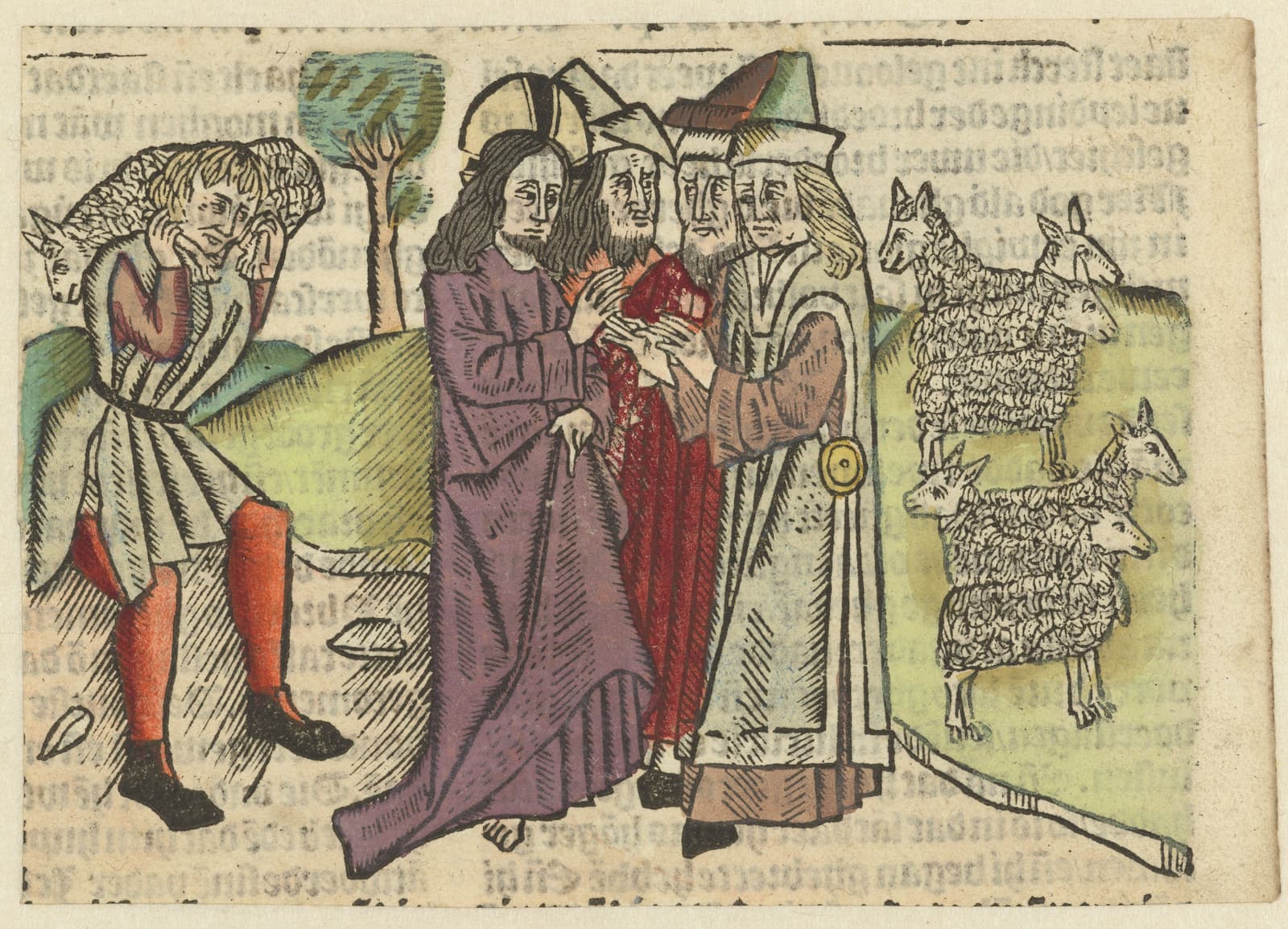
The Lost Sheep
There is no chapter of the New Testament so well known and so dearly loved as the fifteenth chapter of Luke’s Gospel. It has been called “the gospel in the gospel,” as if it contained the very distilled essence of the good news which Jesus came to tell.
These parables arose out of definite situations. It was an offence to the scribes and Pharisees that Jesus associated with men and women who, by the orthodox, were labelled as sinners. The Pharisees gave to people who did not keep the law a general classification. They called them the People of the Land; and there was a complete barrier between the Pharisees and the People of the Land.
To marry a daughter to one of them was like exposing her bound and helpless to a lion. The Pharisaic regulations laid it down, “When a man is one of the People of the Land, entrust no money to him, take no testimony from him, trust him with no secret, do not appoint him guardian of an orphan, do not make him the custodian of charitable funds, do not accompany him on a journey.” A Pharisee was forbidden to be the guest of any such man or to have him as his guest. He was even forbidden, so far as it was possible, to have any business dealings with him.
It was the deliberate Pharisaic aim to avoid every contact with the people who did not observe the petty details of the law. Obviously, they would be shocked to the core at the way in which Jesus companied with people who were not only rank outsiders, but sinners, contact with whom would necessarily defile.
We will understand these parables more fully if we remember that the strict Jews said, not, “There will be joy in heaven over one sinner who repents,” but, “There will be joy in heaven over one sinner who is obliterated before God.” They looked sadistically forward not to the saving but to the destruction of the sinner.
So Jesus told them the parable of the lost sheep and the shepherd’s joy. The shepherd in Judaea had a hard and dangerous task. Pasture was scarce. The narrow central plateau was only a few miles wide, and then it plunged down to the wild cliffs and the terrible devastation of the desert. There were no restraining walls and the sheep would wander.
The shepherd was personally responsible for the sheep. If a sheep was lost the shepherd must at least bring home the fleece to show how it had died. These shepherds were experts at tracking and could follow the straying sheep’s footprints for miles across the hills. There was not a shepherd for whom it was not all in the day’s work to risk his life for his sheep.
Many of the flocks were communal flocks, belonging, not to individuals, but to villages. There would be two or three shepherds in charge. Those whose flocks were safe would arrive home on time and bring news that one shepherd was still out on the mountain side searching for a sheep which was lost. The whole village would be upon the watch, and when, in the distance, they saw the shepherd striding home with the lost sheep across his shoulders, there would rise from the whole community a shout of joy and of thanksgiving.
That is the picture Jesus drew of God; that, said Jesus, is what God is like. God is as glad when a lost sinner is found as a shepherd is when a strayed sheep is brought home. As a great saint said, “God, too, knows the joy of finding things that have gone lost.”
There is a wondrous thought here. It is the truly tremendous truth that God is kinder than men. The orthodox would write off the tax-collectors and the sinners as beyond the pale and as deserving of nothing but destruction; not so God. Men may give up hope of a sinner; not so God. God loves the folk who never stray away; but in his heart there is the joy of joys when a lost one is found and comes home. It is a thousand times easier to come back to God than to come home to the bleak criticism of men. (William Barclay, DSB)
The Lost Coin
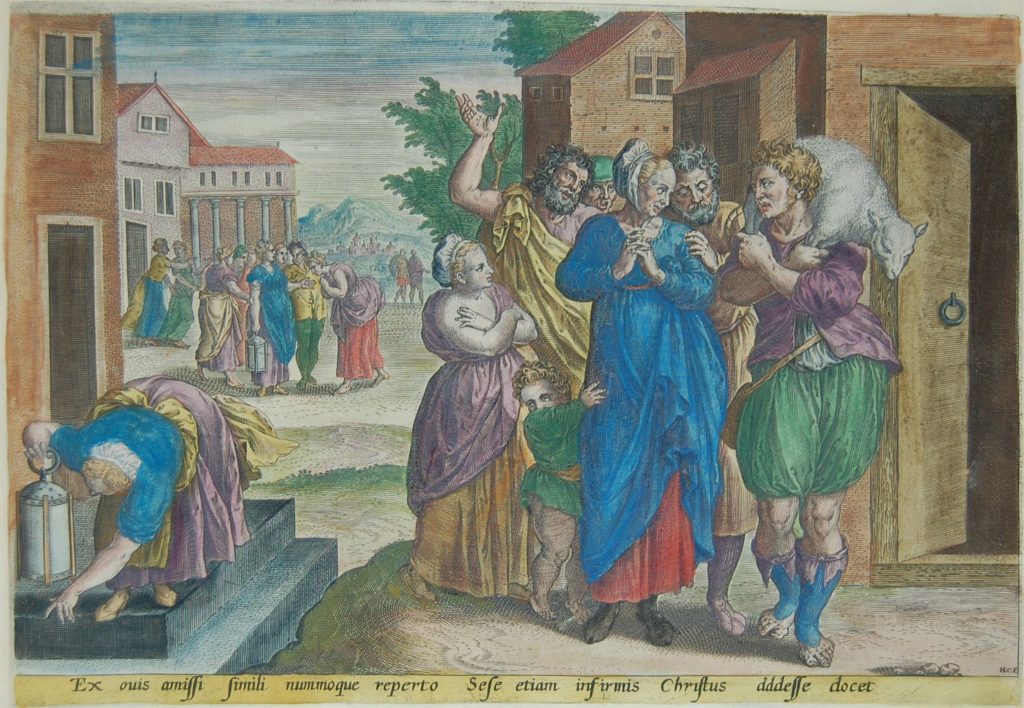
The coin in question in this parable was a silver drachma worth about 4p. It would not be difficult to lose a coin in a Palestinian peasant’s house and it might take a long search to find it. The houses were very dark, for they were lit by one little circular window not much more than about eighteen inches across. The floor was beaten earth covered with dried reeds and rushes; and to look for a coin on a floor like that was very much like looking for a needle in a haystack. The woman swept the floor in the hope that she might see the coin glint or hear it tinkle as it moved.
There are two reasons why the woman may have been so eager to find the coin.
(i) It may have been a matter of sheer necessity. 4p does not sound very much but it was more than a whole day’s wage for a working man in Palestine. These people lived always on the edge of things and very little stood between them and real hunger. The woman may well have searched with intensity because, if she did not find, the family would not eat.
(ii) There may have been a much more romantic reason. The mark of a married woman was a head-dress made of ten silver coins linked together by a silver chain. For years maybe a girl would scrape and save to amass her ten coins, for the head-dress was almost the equivalent of her wedding ring. When she had it, it was so inalienably hers that it could not even be taken from her for debt. It may well be that it was one of these coins that the woman had lost, and so she searched for it as any woman would search if she lost her marriage ring.
In either case it is easy to think of the joy of the woman when at last she saw the glint of the elusive coin and when she held it in her hand again. God, said Jesus, is like that. The joy of God, and of all the angels, when one sinner comes home, is like the joy of a home when a coin which has stood between them and starvation has been lost and is found; it is like the joy of a woman who loses her most precious possession, with a value far beyond money, and then finds it again. (William Barclay, DSB)
No Pharisee had ever dreamed of a God like that. A great Jewish scholar has admitted that this is the one absolutely new thing which Jesus taught men about God—that he actually searched for men. The Jew might have agreed that if a man came crawling home to God in self-abasement and prayed for pity he might find it; but he would never have conceived of a God who went out to search for sinners. We believe in the seeking love of God, because we see that love incarnate in Jesus Christ, the Son of God, who came to seek and to save that which was lost. (William Barclay, DSB)