Continuation of the Holy Gospel according to St. Matthew, 24:15–35
AT THAT TIME, Jesus said to His disciples: When therefore you shall see the abomination of desolation, which was spoken of by Daniel the prophet, standing in the holy place: he that readeth let him understand. Then they that are in Judea, let them flee to the mountains: And he that is on the housetop, let him not come down to take any thing out of his house: And he that is in the field, let him not go back to take his coat. And woe to them that are with child, and that give suck in those days. But pray that your flight be not in the winter, or on the sabbath. For there shall be then great tribulation, such as hath not been from the beginning of the world until now, neither shall be. And unless those days had been shortened, no flesh should be saved: but for the sake of the elect those days shall be shortened. Then if any man shall say to you: Lo here is Christ, or there, do not believe him. For there shall arise false Christs and false prophets, and shall shew great signs and wonders, insomuch as to deceive (if possible) even the elect. Behold I have told it to you, beforehand. If therefore they shall say to you: Behold he is in the desert, go ye not out: Behold he is in the closets, believe it not. For as lightning cometh out of the east, and appeareth even into the west: so shall the coming of the Son of man be. Wheresoever the body shall be, there shall the eagles also be gathered together. And immediately after the tribulation of those days, the sun shall be darkened and the moon shall not give her light, and the stars shall fall from heaven, and the powers of heaven shall be moved: And then shall appear the sign of the Son of man in heaven: and then shall all tribes of the earth mourn: and they shall see the Son of man coming in the clouds of heaven with much power and majesty. And he shall send his angels with a trumpet, and a great voice: and they shall gather together his elect from the four winds, from the farthest parts of the heavens to the utmost bounds of them. And from the fig tree learn a parable: When the branch thereof is now tender, and the leaves come forth, you know that summer is nigh. So you also, when you shall see all these things, know ye that it is nigh, even at the doors. Amen I say to you, that this generation shall not pass, till all these things be done. Heaven and earth shall pass, but my words shall not pass.
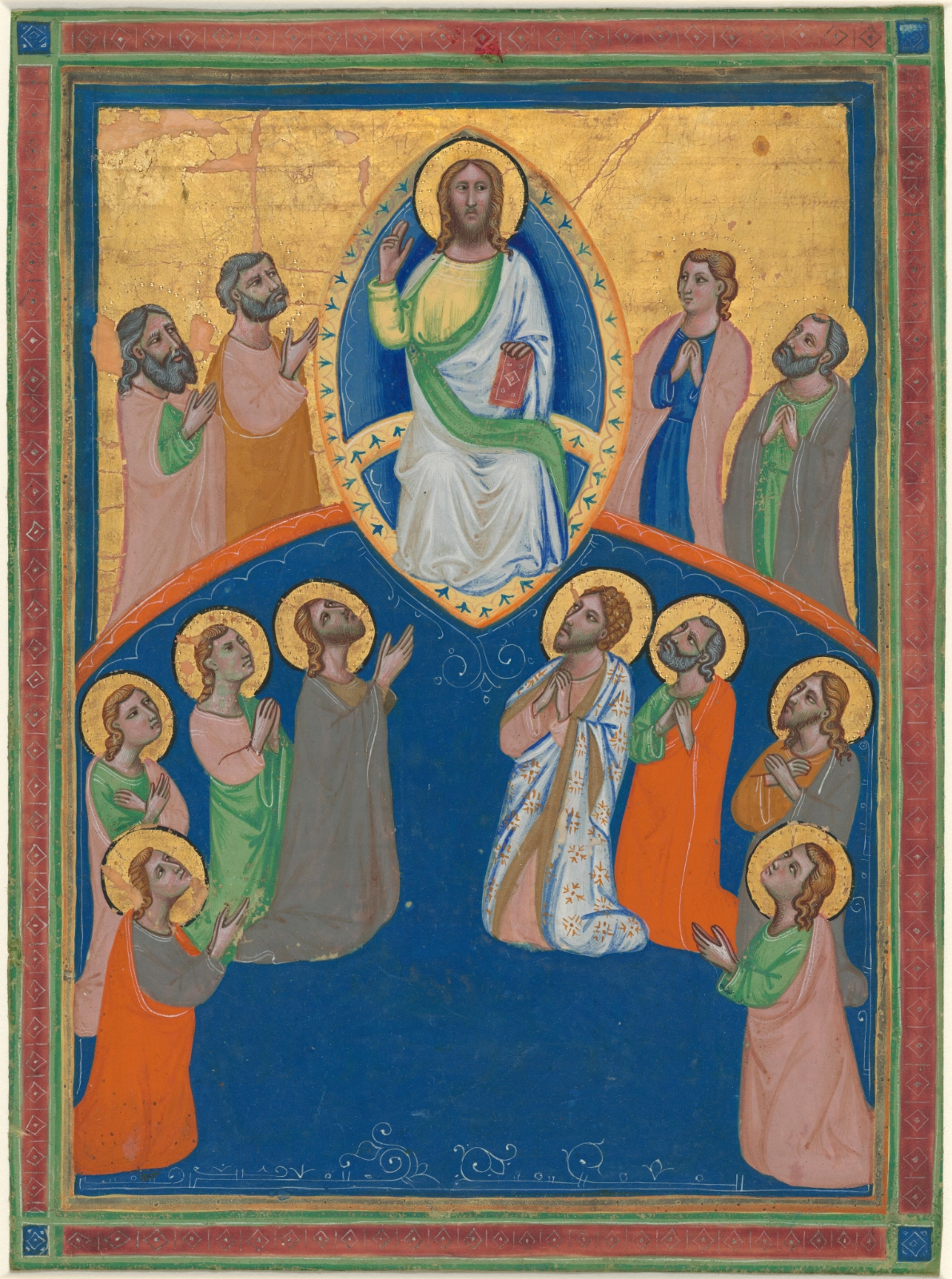
Christ in Majesty with the Twelve Apostles, c. 1320.
National Gallery of Art, Washington.
The number of Sundays after Pentecost may exceed twenty-four and can even reach twenty-eight, depending on whether Easter falls earlier or later in the year. The Mass of this Sunday, however, is always reserved for the last Sunday after Pentecost. The intervening Sundays take their prayers, Epistle and Gospel from the Sundays after Epiphany which could not be celebrated at the beginning of the year. Formerly, the Church regarded the twenty-third Sunday after Pentecost as the proper conclusion of the liturgical year. On that Sunday she contemplated the fulfilment of God’s plan of salvation: Jews and Gentiles, once separated from one another, are united by Christ into one new people. Thus the liturgical year reached its completion in the union of redeemed mankind with Christ. It was only in later centuries that the Church came to conclude the liturgical year with the prophetic announcement of Christ’s Second Coming, when time will come to an end and eternity will begin. Since the Gospel of St Luke already announces this Second Coming at the beginning of Advent, the more extensive prophecy of St Matthew was chosen for the last Sunday after Pentecost.
St Augustine on the Destruction of Jerusalem and the Second Coming of Christ
In his letter to Hesychius, Bishop of Salona in Dalmatia, St Augustine discusses Christ’s prophetic discourse concerning the destruction of Jerusalem and the end of the world. He distinguishes three events: the destruction of Jerusalem, the continual coming of Christ in His Church, and His final coming to judge the living and the dead. The following text is taken from paragraphs 25 to 29 of this letter, written around 419–420. The form of address Your Holiness refers to Bishop Hesychius and was also customary for bishops at that time.
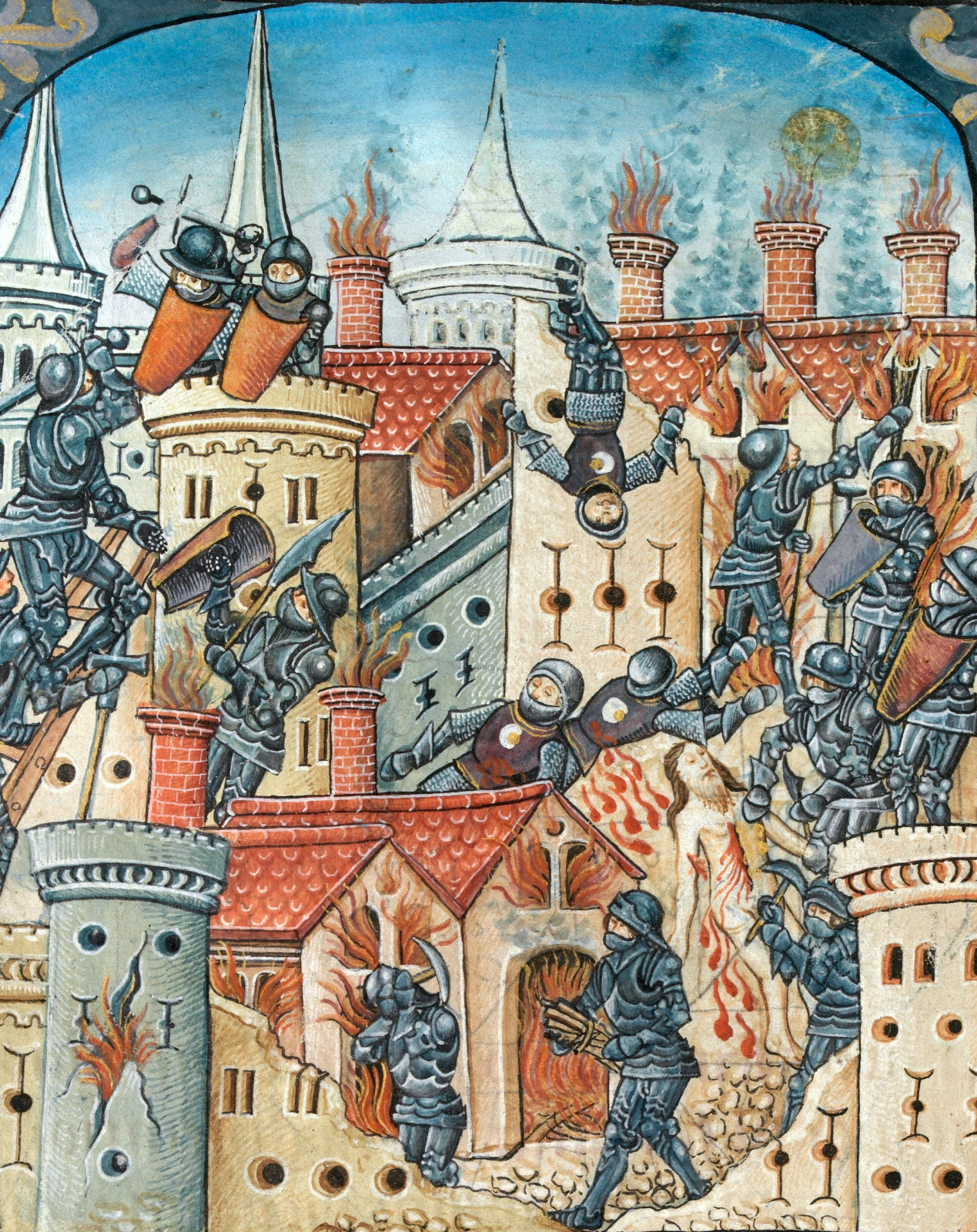
The Siege and Destruction of Jerusalem, c. 1503–1504.
Illumination from the Vaux Passional. National Library of Wales.
§25. The signs of future events foretold in the Gospel according to St Luke are, as Your Holiness observes, the same as those recorded by St Matthew and St Mark. For these three Evangelists relate what the Lord said when His disciples asked Him when the things He had foretold concerning the destruction of the Temple would come to pass, and what would be the sign of His coming and of the consummation of the world. They do not differ in the matters themselves when one mentions something that another omits or expresses differently; rather, when they are compared with one another, they help to guide the understanding of the reader. But it would take too long to discuss everything now. For in answer to their questions, the Lord spoke of the things that would take place from that time onwards: either concerning the destruction of Jerusalem, which had occasioned their question; or concerning His coming through the Church, in which He does not cease to come until the end. For He is recognised as coming in His own, while new members of His Body are born each day. Of this coming He said: Henceforth you shall see the Son of Man coming upon the clouds. Concerning these clouds it was said by the prophet: I will command My clouds that they rain no rain upon her. Or He spoke of the end itself, when He shall appear to judge the living and the dead.
§26. Since, therefore, He speaks of signs relating to these three things, namely, the destruction of that city, His coming in His Body, which is the Church, and His coming in the Head of the Church, which is Himself, we must carefully distinguish which sign belongs to which of these three things. Otherwise, we might take what refers to the destruction of Jerusalem as referring to the end of the world, or, conversely, attribute to the destruction of that city what refers to the end of the world. Or we might say that what refers to His coming in His Body, which is the Church, concerns His final coming in His Body, which is the Head of the Church; or, conversely, maintain that what refers to His final coming in person concerns the coming which takes place through the Church. In all these matters some things are clear, while others are so obscure that it is difficult to judge concerning them, and presumptuous, so long as they are not understood, to assert anything about them with certainty.
§27. Now the words: Woe to those who are with child and to those who give suck in those days. Pray that your flight may not be in winter or on the Sabbath. For then there shall be great tribulation, such as has not been from the beginning of the world, nor ever shall be, are recorded by Matthew and Mark in such a manner that it is uncertain whether they should be understood of the destruction of that city or of the end of the world. In Mark the same passage reads as follows: Woe to those who are with child and to those who give suck in those days. Pray that it may not happen in winter. For those days shall be days of tribulation, such as has not been from the beginning of the creation which God created until now, nor ever shall be. And unless the Lord had shortened those days, no flesh should be saved; but for the sake of the elect whom He has chosen, He has shortened the days. Matthew speaks no differently. Luke, however, has related it in such a way that it becomes clear that it refers to the destruction of that city. For in his Gospel we read: Woe to those who are with child and to those who give suck in those days; for there shall be great distress upon the earth and wrath upon this people. And they shall fall by the edge of the sword and shall be led away captive among all nations; and Jerusalem shall be trodden down by the Gentiles until the times of the Gentiles are fulfilled.§28. How these words are introduced is related by Matthew as follows: When therefore you shall see the abomination of desolation, which was spoken of by Daniel the prophet, standing in the holy place, let him who reads understand, then let those who are in Judea flee to the mountains; and let him who is on the housetop not come down to take anything out of his house, and let him who is in the field not return to take his garment. Woe to those who are with child and to those who give suck in those days, and so forth. Mark, however, writes as follows: When you shall see the abomination of desolation standing where it ought not, let him who reads understand, then let those who are in Judea flee to the mountains; and let him who is on the housetop not come down, nor enter the house to take anything out of it; and let him who is in the field not return to take his garment. Woe to those who are with child and to those who give suck in those days, and so forth. Luke, on the other hand, records in the same place these words of the Lord, showing that the abomination of desolation foretold by Daniel took place when Jerusalem was captured: When you shall see Jerusalem surrounded by an army, know then that its desolation is near. It is thus evident that the abomination of desolation, of which the other two Evangelists have spoken, then stood in that place. Luke then continues in the same manner: Then let those who are in Judea flee to the mountains. And where the others have said: Let him who is on the housetop not come down, nor enter the house to take anything out of it, Luke says: And let those who are within the city depart from it. This shows that the words of the other Evangelists prescribe the necessary haste in flight. And where the others write: Let him who is in the field not return to take his garment, Luke says more clearly: And let those who are in the surrounding country not enter into it, for these are the days of vengeance, that all things which are written may be fulfilled. Afterwards he continues in a corresponding manner, so that it is perfectly clear that this Gospel passage in all three Evangelists concerns the same event: Woe to those who are with child and to those who give suck in those days, and the remaining words which relate to it and which I have already mentioned above.
§29. Luke has therefore made clear what might otherwise have remained uncertain, namely, that what is said concerning the abomination of desolation and what is said concerning the shortening of the days for the sake of the elect refers not to the end of the world but to the siege of Jerusalem. For although he has not himself mentioned these things, he has more clearly described other matters concerning the same event, and has thereby shown that those words also refer to it. For we must not doubt that among that people, when Jerusalem was destroyed, there were elect of God who had come, or would yet come, to the faith from the circumcision, having been chosen before the foundation of the world. For their sake those days were shortened, so that the calamities might become bearable. Some seem to me to have understood the matter more correctly when they hold that by the days are meant the calamities themselves, just as elsewhere in Holy Scripture mention is made of evil days. For the days themselves are not evil, but the things that happen in them. Therefore it is said that these things were shortened, so that through the patience granted by God they might be felt less grievously, and thus what was great might become short.
St Augustine, Epistula 199 ad Hesychium, §§25–29, De fine saeculi. English translation from the Latin text, CSEL 57.
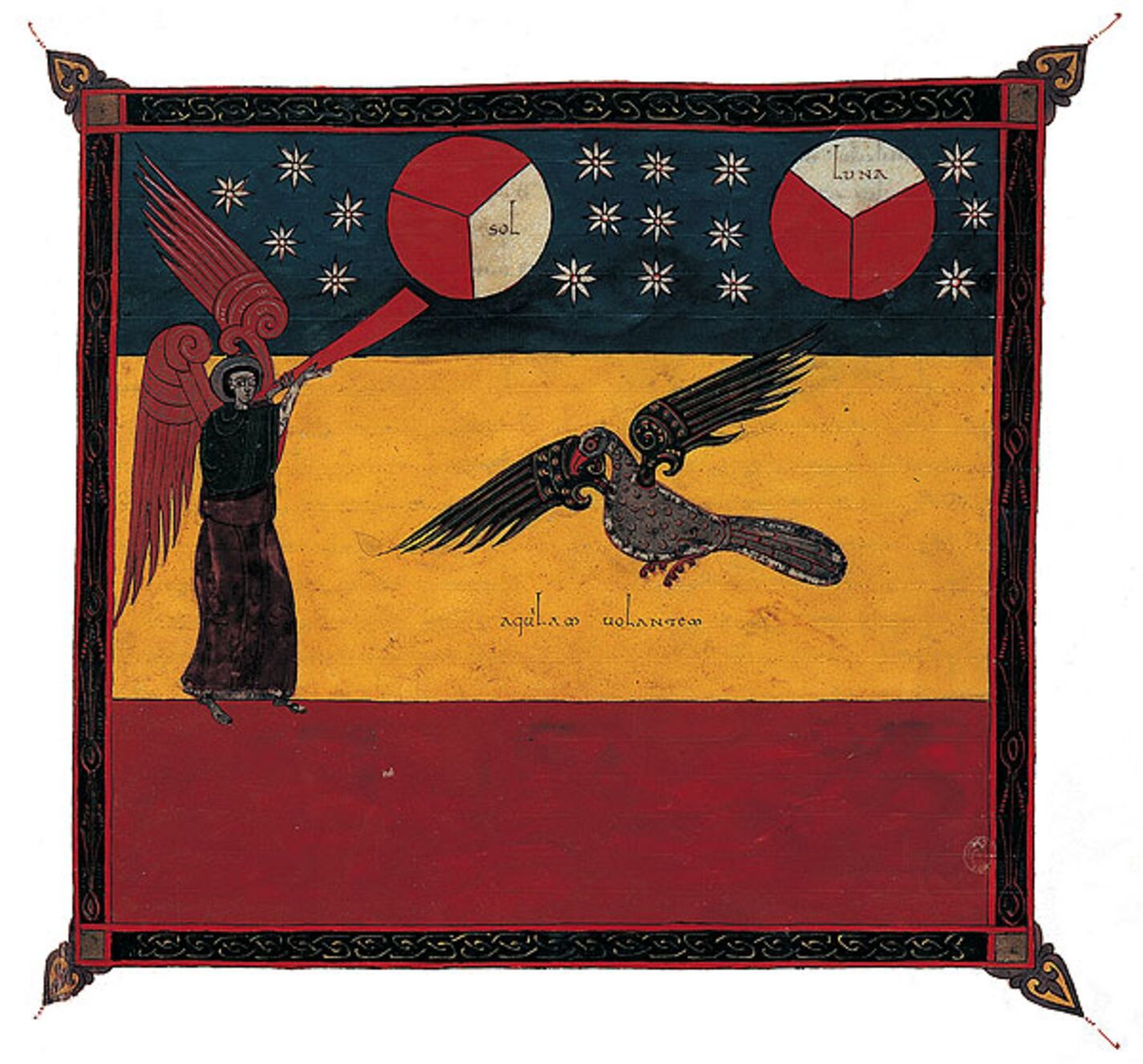
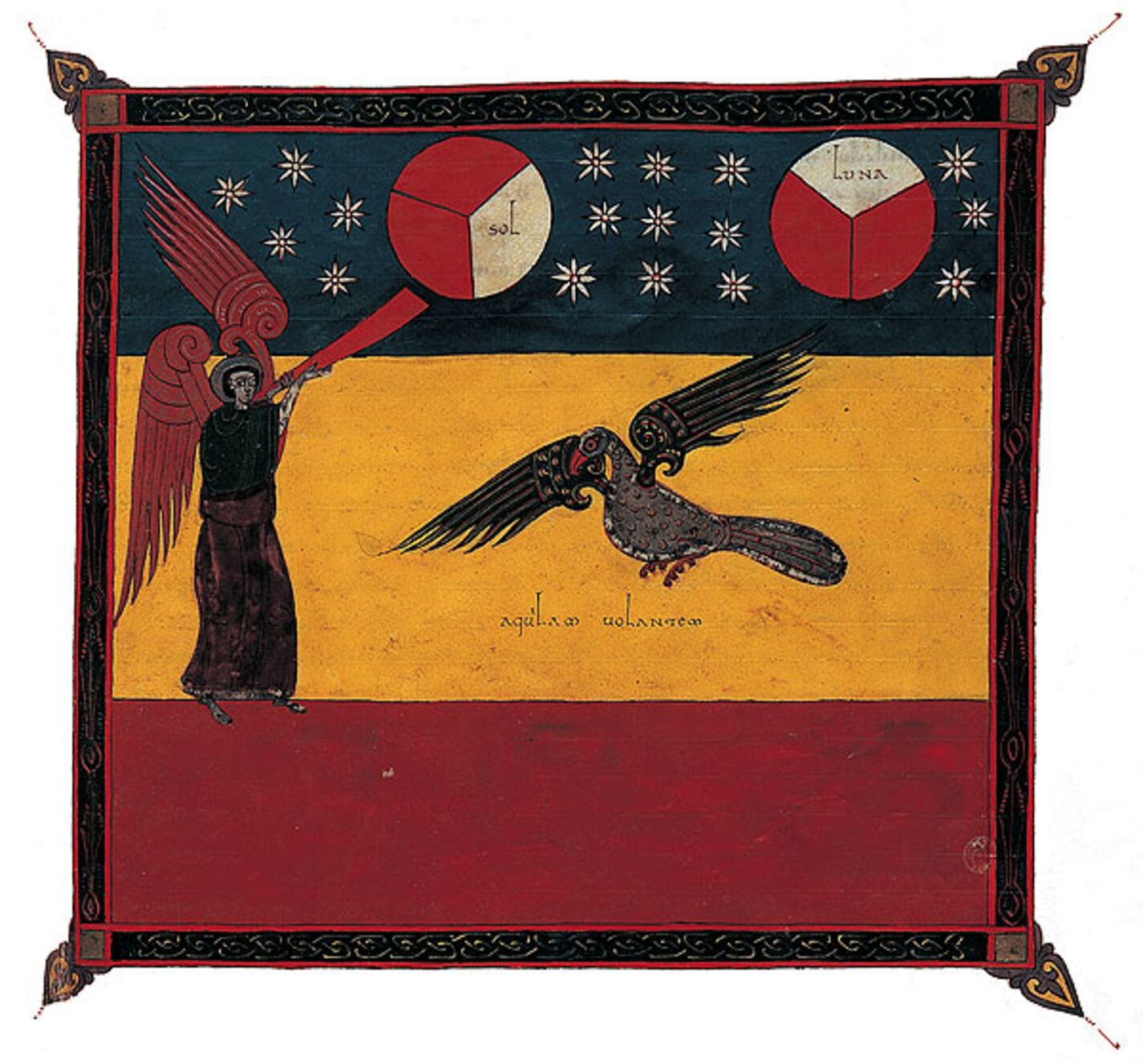
The Fourth Angel Sounding the Trumpet, Revelation 8:12–13.
Illumination from the Beatus of Ferdinand I and Sancha, 1047. Madrid.