Gospel of the Twentieth Sunday after Pentecost (John 4:46–53)
AT THAT TIME, He came again therefore into Cana of Galilee, where he made the water wine. And there was a certain ruler, whose son was sick at Capharnaum. He having heard that Jesus was come from Judea into Galilee, went to him, and prayed him to come down, and heal his son; for he was at the point of death. Jesus therefore said to him: Unless you see signs and wonders, you believe not. The ruler saith to him: Lord, come down before that my son die. Jesus saith to him: Go thy way; thy son liveth. The man believed the word which Jesus said to him, and went his way. And as he was going down, his servants met him; and they brought word, saying, that his son lived. He asked therefore of them the hour wherein he grew better. And they said to him: Yesterday, at the seventh hour, the fever left him. The father therefore knew, that it was at the same hour that Jesus said to him, Thy son liveth; and himself believed, and his whole house.
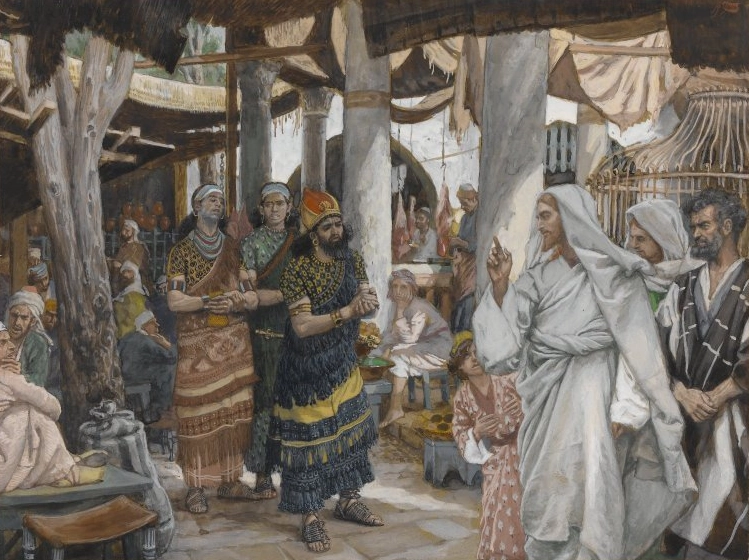
St. John Chrysostom, Homily XXXV on the Gospel of John (John 4:46–53)
So Jesus came again into Cana of Galilee, where He made the water wine. The Evangelist reminds the hearer of the miracle to exalt the praise of the Samaritans. The men of Cana received Him by reason of the miracles which He had done in Jerusalem and in that place; but not so the Samaritans, they received Him through His teaching alone. That He came then to Cana, the Evangelist has said, but he has not added the cause why He came. Into Galilee He had come because of the envy of the Jews; but wherefore to Cana? At first He came, being invited to a marriage; but wherefore now? Methinks to confirm by His presence the faith which had been implanted by His miracle, and to draw them to Him the more by coming to them self-invited, by leaving His own country, and by preferring them. And there was a certain nobleman whose son was sick at Capernaum. When he heard that Jesus had come out of Judæa into Galilee, he went unto Him and besought Him that He would come down and heal his son. This person certainly was of royal race, or possessed some dignity from his office, to which the title noble was attached. Some indeed think that this is the man mentioned by Matthew (Matthew 8:5), but he is shown to be a different person, not only from his dignity, but also from his faith. That other, even when Christ was willing to go to him, entreats Him to tarry; this one, when He had made no such offer, draws Him to his house. The one says, I am not worthy that You should come under my roof; but this other even urges Him, saying, Come down ere my son die. In that instance He came down from the mountain, and entered into Capernaum; but here, as He came from Samaria, and went not into Capernaum but into Cana, this person met Him. The servant of the other was possessed by the palsy, this one’s son by a fever. And he came and besought Him that He would heal his son: for he was at the point of death. What says Christ? Unless you see signs and wonders, you will not believe. Yet the very coming and beseeching Him was a mark of faith. And besides, after this the Evangelist witnesses to him, declaring that when Jesus said, Go, your son lives, he believed His word, and went. What then is that which He says here? Either He uses the words as approving of the Samaritans because they believed without signs; or, to touch Capernaum which was thought to be His own city, and of which this person was. Moreover, another man in Mark, who says, Lord, I believe, said besides, help my unbelief. (Mark 9:24) And so if this ruler also believed, yet he believed not entirely or soundly, as is clear from his enquiring at what hour the fever left him, since he desired to know whether it did so of its own accord, or at the bidding of Christ. When therefore he knew that it was yesterday at the seventh hour, then himself believed and his whole house. Do you see that he believed when his servants, not when Christ spoke? Therefore He rebukes the state of mind with which he had come to Him, and spoken as he did, (thus too He the more drew him on to belief,) because that before the miracle he had not believed strongly. That he came and entreated was nothing wonderful, for parents in their great affection are also wont to resort not only to physicians in whom they have confidence, but also to talk with those in whom they have no confidence, desiring to omit nothing whatever. Indeed, that he came without any strong purpose appears from this, that when Christ had come into Galilee, then he saw Him, whereas if he had firmly believed in Him, he would not, when his child was on the point of death, have hesitated to go into Judæa. Or if he was afraid, this is not to be endured either. Observe how the very words show the weakness of the man; when he ought, after Christ had rebuked his state of mind, to have imagined something great concerning Him, even if he did not so before, listen how he drags along the ground. Sir, come down ere my child die. As though He could not raise him after death, as though He knew not what state the child was in. It is for this that Christ rebukes him and touches his conscience, to show that His miracles were wrought principally for the sake of the soul. For here He heals the father, sick in mind, no less than the son, in order to persuade us to give heed to Him, not by reason of His miracles, but of His teaching. For miracles are not for the faithful, but for the unbelieving and the grosser sort. At that time then, owing to his emotion, the nobleman gave no great heed to the words, or to those only which related to his son, yet he would afterwards recollect what had been said, and draw from thence the greatest advantage. As indeed was the case. But what can be the reason why in the case of the centurion He by a free offer undertook to come, while here though invited, He goes not? Because in the former case faith had been perfected, and therefore He undertook to go, that we might learn the rightmindedness of the man; but here the nobleman was imperfect. When therefore he continually urged Him, saying, Come down, and knew not yet clearly that even when absent He could heal, He shows that even this was possible unto Him in order that this man might gain from Jesus not going, that knowledge which the centurion had of himself. And so when He says, Unless you see signs and wonders, you will not believe, His meaning is, You have not yet the right faith, but still feel towards Me as towards a Prophet. Therefore to reveal Himself and to show that he ought to have believed even without miracles, He said what He said also to Philip, Believest thou that the Father is in Me and I in the Father? Or if not, believe Me for the very works’ sake. (John 14:10–11) And as he was now going down, his servants met him, and told him, saying, Your son lives. Then enquired he of them the hour when he began to amend. And they said to him, Yesterday at the seventh hour the fever left him. So the father knew that it was at the same hour in the which Jesus said to him, Your son lives; and himself believed, and his whole house. Do you see how evident the miracle was? Not simply nor in a common way was the child freed from danger, but all at once, so that what took place was seen to be the consequence not of nature, but the working of Christ. For when he had reached the very gates of death, as his father showed by saying, Come down ere my child die; he was all at once freed from the disease. A fact which roused the servants also, for they perhaps came to meet their master, not only to bring him the good news, but also deeming that the coming of Jesus was now superfluous, (for they knew that their master had gone there,) and so they met him even in the way. The man released from his fear, thenceforth escaped into faith, being desirous to show that what had been done was the result of his journey, and thenceforth he is ambitious of appearing not to have exerted himself to no purpose; so he ascertained all things exactly, and himself believed and his whole house. For the evidence was after this unquestionable. For they who had not been present nor had heard Christ speak nor known the time, when they had heard from their master that such and such was the time, had incontrovertible demonstration of His power. Wherefore they also believed. What now are we taught by these things? Not to wait for miracles, nor to seek pledges of the Power of God. I see many persons even now become more pious, when during the sufferings of a child or the sickness of a wife they enjoy any comfort, yet they ought even if they obtain it not, to persist just the same in giving thanks, in glorifying God. Because it is the part of right-minded servants, and of those who feel such affection and love as they ought for their Master, not only when pardoned, but also when scourged, to run to Him. For these also are effects of the tender care of God; Whom the Lord loves He chastens, and scourges, it says, every son whom He receives. (Hebrews 12:6) When therefore a man serves Him only in the season of ease, he gives proofs of no great love, and loves not Christ purely. And why speak I of health, or abundant riches, or poverty, or disease? Should thou hear of the fiery pit or of any other dreadful thing, not even so must thou cease from speaking good of your Master, but suffer and do all things because of your love for Him. For this is the part of right-minded servants and of an unswerving soul; and he who is disposed after this sort will easily endure the present, and obtain good things to come, and enjoy much confidence in the presence of God; which may it be that we all obtain through the grace and lovingkindness of our Lord Jesus Christ, to whom with the Father and the Holy Ghost be glory, now and ever, and world without end. Amen.