AT THAT TIME, when Jesus drew near Jerusalem, seeing the city, He wept over it, saying: If thou also hadst known, and that in this thy day, the things that are to thy peace: but now they are hidden from thy eyes. For the days shall come upon thee: and thy enemies shall cast a trench about thee, and compass thee round, and straiten thee on every side, and beat thee flat to the ground, and thy children who are in thee: and they shall not leave in thee a stone upon a stone: because thou hast not known the time of thy visitation. And entering into the temple, He began to cast out them that sold therein, and them that bought, saying to them: It is written, My house is the house of prayer: but you have made it a den of thieves. And He was teaching daily in the temple.
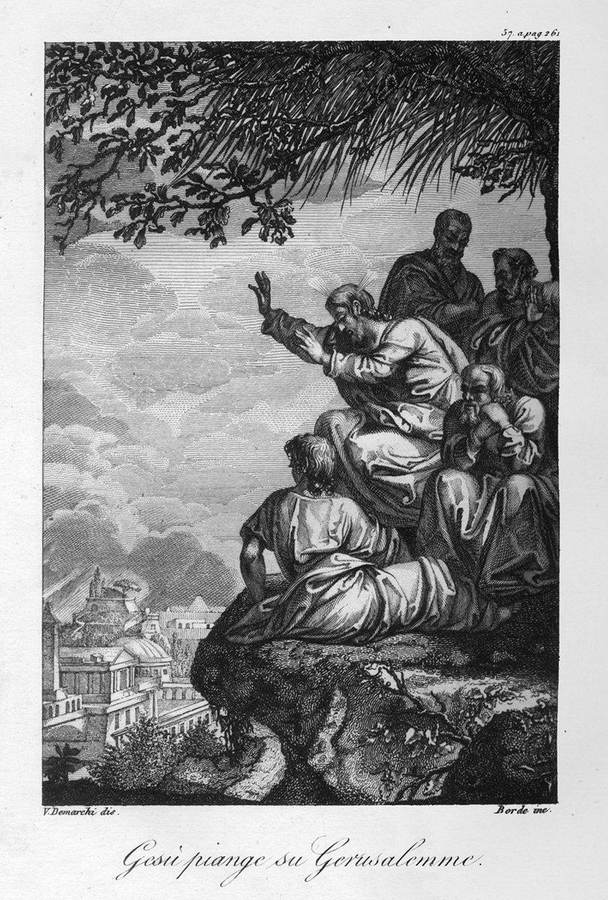
Christ Weeps over Jerusalem
As the Lord drew near and beheld the city, He wept over it. Shortly before, He had been received into Jerusalem with cries of joy as the Messias (Luke 19:35–40). He had been sent to His people as the promised Messias and Saviour, yet Jerusalem refused to acknowledge Him. While the multitude around Him cried Hosanna and rejoiced at His solemn entry, He beheld the judgment that was soon to come upon the city.
His tears had three causes. First, He wept over the blindness, obstinacy, and ingratitude of the people. Jerusalem possessed the Law and the Prophets, had heard His preaching and witnessed His miracles, yet would not acknowledge her Messias. Secondly, He wept over the punishment that would befall the city and its people: the siege, the famine, and the destruction which Titus would bring upon Jerusalem. Lastly, He wept because He saw that His labours would remain fruitless for many. He had taught, admonished, healed, and wrought miracles, yet many would reject His grace and persevere in their unbelief. These three causes drew tears from His eyes. His sorrow sprang from the greatness of His love. Origen observes that Christ Himself fulfilled the Beatitudes. Having declared blessed those who mourn, He Himself also wept.
Hadst Thou Also Known
The Lord then addresses His lament to Jerusalem. He speaks as her Messias, Who had come to bring her salvation. Had she acknowledged Him, she would have listened to Him, believed in Him, and not have perished. The words of Christ remain unfinished. The intensity of His sorrow breaks off the sentence. Jerusalem ought not only to have recognised Who He was, but also what belonged to her peace and salvation. This peace embraces every good and every security, both for body and soul, and above all peace with God and everlasting salvation.
In these words Christ laments the ingratitude of Jerusalem. For her sake He had come down from heaven and had been born. For three years He had taught and preached throughout her cities and villages. He had cleansed her lepers, healed her sick, delivered those possessed by devils, and raised her dead. Yet she turned away from Him and rejected her Messias. The day would come when Jerusalem would recognise her blindness, but then the time of her visitation would have passed, and judgment would fall upon the city.
After Cornelius a Lapide, Commentary on Luke 19:41–42.
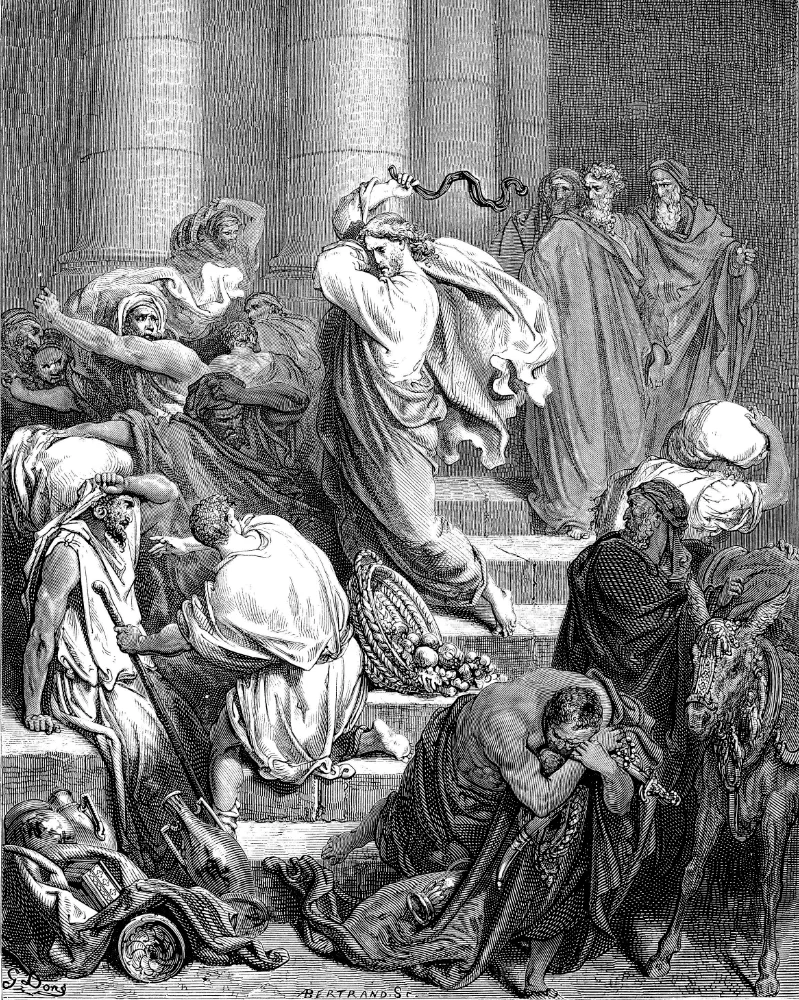
The Cleansing of the Temple
After Christ had wept over Jerusalem, He entered the Temple and drove out the buyers and sellers. Thus He began to manifest His royal authority. It is remarkable that no one dared resist Him while He disrupted the trade and overthrew the profits of the priests. Saint Jerome regards this as one of Christ’s greatest miracles. Alone, armed only with a scourge, He drove out a great multitude, overturned the tables of the money changers, and cast down the seats of those who sold doves. A divine majesty shone forth from His countenance, so that all drew back before Him.
It is wonderful that no one resisted a single poor Man while He overthrew the profits of the priests. Saint Jerome considers this one of Christ’s greatest miracles. Alone, with but one scourge, He drove out so great a multitude, overturned the tables, and cast down the seats, a feat which scarcely a great army could have accomplished. A certain fiery splendour shone from His eyes, and the majesty of the Godhead was manifest upon His countenance.
By the Temple is here understood the outer court, where the people assembled to pray and to attend the sacrifices. There sheep, oxen, lambs, and doves were sold for the sacrificial offerings, while the money changers exchanged foreign coins for the Temple currency. In themselves these things were necessary for divine worship, yet they ought not to have taken place within the sacred precincts of the Temple. Moreover, they were accompanied by greed and the desire for gain. Therefore Christ calls them a den of thieves. Under the appearance of religion they sought their own profit.
Therefore Christ drove out both sellers and buyers, saying, My house is the house of prayer: but you have made it a den of thieves. Thus He also fulfilled the words of the Psalmist: The zeal of Thy house hath eaten Me up. Saint Bede remarks: What would the Lord do if He found in His Temple men quarrelling, listening to idle tales, laughing, or giving themselves over to other unseemly behaviour, seeing that He drove out even those who sold the animals appointed for His own sacrifices?
By a den of thieves Christ means those who seek gain from religion. As robbers hide themselves in a cave from which they go forth to plunder, so these merchants concealed their greed beneath the appearance of the Temple service. Therefore Christ cleansed His Father’s house of everything that was contrary to its sacred purpose.
After Cornelius a Lapide, Commentary on Luke 19:45–46 and Matthew 21:12–13.